FREE SHIPPING OVER $50

Men: Strong Glutes Are the Secret to Better Lifts, Less Back Pain, and More Power—Here Are 6 Exercises

If you spend your leg days prioritizing heavy quad extensions, leg presses, and calf raises while treating direct glute training like an optional aesthetic luxury, you are leaving massive athletic power on the table while inviting chronic lower back pain. As the largest muscle group in the human body, the gluteus maximus serves as your biological engine for explosive hip extension, sprint velocity, and heavy deadlift lockouts. However, modern desk jobs and prolonged sitting cause “glute amnesia”—a condition where your brain loses its ability to recruit your glutes efficiently, forcing your lower spine and hamstrings to overwork. By targeting your posterior chain with specific strength exercises, you can unlock immediate power gains in your compound lifts, protect your lumbar spine, and move with explosive agility.
The Anatomy of Power: Why Men Need Glute Strength
To understand why weak glutes sabotage your physical performance, you have to look at how force transfers across your kinetic chain. The gluteal complex consists of three primary muscles: the gluteus maximus, gluteus medius, and gluteus minimus.
Together, these muscles drive hip extension, stabilize your pelvis during single-leg movements, and rotate your thighs outward.
When your glutes are weak or inactive, your body compensates through a process called gluteal amnesia or glute inhibition.
Without glute recruitment, your lower back muscles (erector spinae) and hamstrings take on heavy loads they were never designed to support alone.
This structural compensation leads directly to lower back compression, tight hip flexors, and a plateau on heavy compound lifts like squats and deadlifts.
“The glutes are the power center of the human body. When they sleep on the job, your lower back pays the price and your lifting strength stalls out.”
At a Glance: Inactive Glutes vs. Activated Posterior Chain
Comparing a body with dormant glutes against an active posterior chain highlights how targeted training transforms your strength profile.
| Performance Metric | Dormant Glute Profile (Glute Amnesia) | Targeted Glute Strength Profile |
| Squat & Deadlift Mechanics | Stalls at lockout; lower back rounds under load | Explosive hip drive; rock-solid lockout power |
| Lower Back Stress | High lumbar shear strain & spinal compression | Minimal back pain; glutes absorb force loads |
| Sprinting & Vertical Jump | Slow force production from weak hip extension | Maximum acceleration & sprint power output |
| Pelvic Stability | Anterior pelvic tilt; tight hip flexors | Neutral pelvic alignment & healthy posture |
The 6 Best Glute Exercises for Men
Integrating these six targeted movements into your weekly strength routine activates your hips, builds muscle density, and shields your lower back:
1. The Barbell Hip Thrust
The barbell hip thrust is the undisputed king of horizontal hip extension exercises. Unlike squats, which place peak tension on your quads at the bottom position, hip thrusts put peak resistance on your glutes right at full lockout.
Sit on the floor with your upper back resting against a sturdy bench, roll a loaded barbell over your hips (using a thick barbell pad for comfort), and plant your feet flat on the ground shoulder-width apart.
Drive through your heels to extend your hips upward until your knees, hips, and shoulders form a straight bridge.
Squeeze your glutes forcefully at the top for one full second before lowering with control, aiming for 3 to 4 sets of 8 to 12 reps.
2. Romanian Deadlifts (RDLs)
Romanian deadlifts focus heavily on the eccentric hinge phase, loading your hamstrings and glutes under intense muscular tension.
Stand upright holding a barbell or pair of heavy dumbbells in front of your thighs with a shoulder-width stance.
Keep a slight bend in your knees, push your hips backward as if touching a wall behind you, and lower the weights along your shins while maintaining a flat spine.
Once you feel a deep stretch in your hamstrings, contract your glutes tightly and drive your hips forward to stand tall.
Perform 3 sets of 8 to 10 reps to build a thick, resilient posterior chain.
3. Bulgarian Split Squats
Unilateral training isolates each leg individually, exposing hidden muscle imbalances while building bulletproof pelvic stability.
Stand a couple of feet in front of a flat workout bench and place the top of your back foot flat on the bench behind you.
Hold dumbbells at your sides, lower your back knee toward the floor until your front thigh reaches parallel, and keep your torso tilted slightly forward to load your front glute.
Drive through your front heel to return to the top position, completing 3 sets of 8 reps per leg.
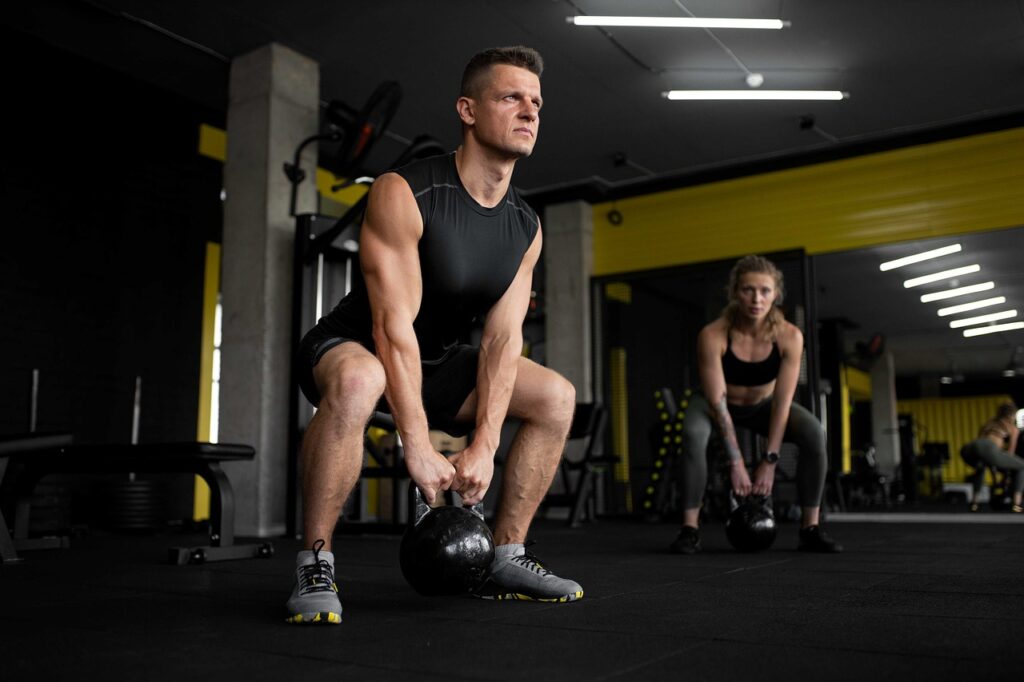
4. Kettlebell Swings
Kettlebell swings train rapid, explosive hip extension, making them ideal for building cardiovascular conditioning and athletic power.
Stand over a kettlebell with a wide stance, hinge at your hips to grab the handle, and hike the kettlebell back between your legs like a football snap.
Snap your hips forward explosively, squeezing your glutes tightly to float the kettlebell to chest height without using your arms to pull.
Let the kettlebell fall back into the hip hinge rhythmically for 3 to 4 sets of 15 to 20 reps.
5. Cable Pull-Throughs
Cable pull-throughs provide a low-stress alternative for teaching proper hip hinge mechanics without compressing your spine.
Set a cable pulley to the lowest setting with a rope attachment and stand facing away from the machine with the rope between your legs.
Hinge at your hips, reaching your hands backward between your thighs while keeping your back flat.
Drive your hips forward and squeeze your glutes at the top lockout, performing 3 sets of 12 to 15 reps.
6. Banded 45-Degree Back Extensions
Modifying the traditional back extension bench targets your glutes over your lower back.
Set up on a 45-degree hyperextension bench, round your upper back slightly to take your back muscles out of the lift, and turn your toes outward at a 45-degree angle.
Lower your torso, then squeeze your glutes to raise your body until your hips are extended, holding a light weight plate against your chest.
Execute 3 sets of 12 to 15 reps to finish off your workout with maximum metabolic fatigue.
2 Common Glute Training Mistakes Men Make
Steering clear of these common gym errors ensures every repetition builds real strength instead of straining your joints:
Mistake 1: Arching Your Lower Back at Lockout
Hyper-extending your lower back at the top of a hip thrust or deadlift shifts tension off your glutes and compresses your lumbar vertebrae. Always tuck your chin slightly and tilt your pelvis posteriorly at lockout.
Mistake 2: Driving Through Your Toes Instead of Your Heels
Pushing off the balls of your feet shifts work straight to your quads. Keep your feet flat and drive through your heels to engage your posterior chain.
Related Articles
- I Built More Strength in My Living Room Than the Gym—Here’s How To Build Real Strength Anywhere
- I’m a Strength Coach—90% of Gym-Goers Train Triceps Wrong (Here’s the Smarter Way to Actually Grow Them)
- Want Strong, Toned Arms? Try This Trainer’s 8-Exercise Routine Today
- 5 Low-Impact Exercises to Strengthen Your Whole Body—No Jumping Needed
- 15 Minutes, One Set of Dumbbells: Your Ultimate Full-Body Workout Solution