FREE SHIPPING OVER $50

The Longevity Secret for Women: Why Strength Training in Your 30s, 40s, and 50s Changes Everything

For decades, mainstream fitness advice told women that spending hours doing steady-state cardio on a treadmill or elliptical was the ultimate formula for staying lean, healthy, and youthful. However, longevity researchers and exercise physiologists now recognize that progressive strength training is the single most powerful biological intervention for women entering their 30s, 40s, 50s, and beyond. As estrogen levels begin to fluctuate during peri-menopause and menopause, women naturally experience an accelerated loss of lean muscle mass, declining bone mineral density, and a slowing resting metabolic rate. Swapping light pink dumbbells and endless cardio sessions for heavy compound resistance training changes everything: it stimulates bone remodeling, preserves functional independence, sharpens insulin sensitivity, and turns your body into a metabolic furnace that thrives for decades to come.
The Biological Reality of Female Muscle and Bone Loss
To understand why strength training becomes an absolute non-negotiable health habit after age 30, you have to look at the hormonal shifts that take place inside the female body. Starting around age 30, women naturally begin to lose approximately 3 to 8 percent of their muscle mass per decade—a process known as sarcopenia.
When perimenopause arrives in your 40s, declining estrogen levels dramatically accelerate this muscle loss while simultaneously impairing bone mineral density.
Estrogen acts as a primary regulator of osteoblasts, the specialized cells responsible for laying down new bone tissue.
Without estrogen’s protective signal, bone breakdown outpaces bone formation, increasing your long-term risk for osteopenia and osteoporosis.
Progressive resistance training places mechanical stress on your skeletal system, bending the bone micro-structures slightly.
This mechanical stress signals osteoblasts to deposit fresh calcium and collagen, rebuilding bone density precisely where you need it most.
“Cardio conditions your heart, but heavy strength training rebuilds your skeleton and preserves your metabolism. It is the ultimate anti-aging prescription for women.”
At a Glance: Endless Cardio vs. Progressive Strength Training
Comparing traditional cardio-only routines against progressive strength training highlights why lifting weights delivers superior anti-aging protection.
| Health & Longevity Metric | Cardio-Only Routine (Treadmill/Elliptical) | Progressive Resistance Training |
| Lean Muscle Preservation | Minimal protection; can promote muscle breakdown | Maximal hypertrophy & muscle retention |
| Bone Density Stimulation | Low impact; insufficient for bone remodeling | High mechanical load; stimulates bone building |
| Resting Metabolic Rate | Burns calories during exercise only | Elevates baseline metabolic rate 24/7 |
| Insulin Sensitivity & Fat Loss | Moderate glucose clearance | Dramatically improves insulin receptor sensitivity |
| Joint & Spine Longevity | Repetitive impact can wear down cartillage | Strengthens connective tissue & stabilizes joints |
How Strength Training Transforms Each Decade
Understanding how your physiological needs shift across your 30s, 40s, and 50s ensures you tailor your resistance training routine for maximum lifespan benefits:
Your 30s: Building Your Peak Metabolic Reserve
Your 30s are all about establishing a massive peak muscle and bone mass reserve before age-related hormonal shifts kick in. Lifting heavy weights two to three times a week builds a thick muscular foundation, solidifies bone density, and maintains a high resting metabolic rate through busy career and family years.
Your 40s: Fighting Perimenopausal Muscle Loss
During your 40s, fluctuating estrogen levels make preserving lean muscle challenging. Incorporating progressive overload with barbells, dumbbells, or resistance bands prevents abdominal fat accumulation, combats perimenopausal brain fog, and keeps your insulin sensitivity sharp.
Your 50s and Beyond: Protecting Independence and Bone Health
In your 50s, post-menopausal changes make bone protection and joint stability urgent priorities. Heavy lifting stimulates bone remodeling in vulnerable areas like your hips and lower spine while improving single-leg balance to eliminate fall risks and preserve lifelong physical independence.
4 Essential Compound Exercises Every Woman Should Master
Focusing on multi-joint compound movements delivers the highest metabolic return and bone-density stimulus in minimal workout time:
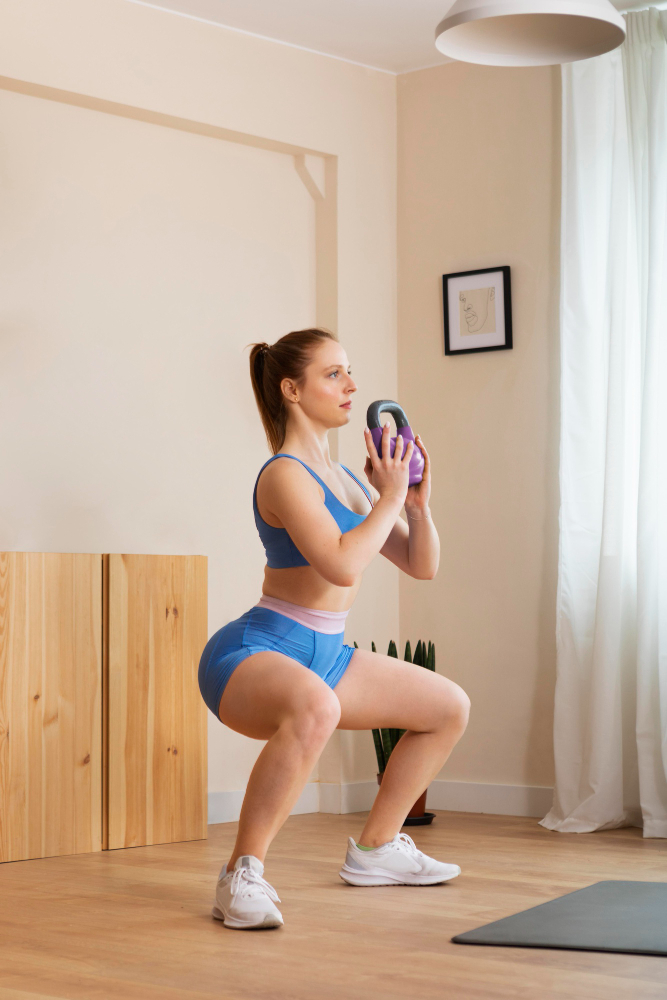
- The Goblet Squat: Holding a dumbbell or kettlebell close to your chest while squatting deep strengthens your quads, glutes, and core while loading your hip joints safely.
- The Romanian Deadlift (RDL): Hinging at your hips while keeping your back flat loads your hamstrings and glutes, strengthening your posterior chain and protecting your lower lumbar spine.
- The Overhead Dumbbell Press: Pressing weights directly overhead builds strong shoulders, upper back posture, and arm strength while loading your spine to support bone density.
- The Dumbbell Inverted Row: Pulling resistance toward your ribs strengthens your upper back muscles, correcting forward slouching and stabilizing your shoulder blades.
2 Common Myths Keeping Women Away From Heavy Weights
Clearing up these persistent fitness myths empowers you to pick up heavier weights with total confidence:
Myth 1: “Lifting Heavy Weights Will Make Me Look Bulky”
Women lack the high circulating testosterone levels required to build massive, bulky muscles naturally. Lifting heavy weights builds tight, toned, dense muscle tissue that pulls your waistline inward and creates an athletic silhouette.
Myth 2: “Light Hand Weights with High Reps Is Best for Women”
Using two-pound pink dumbbells for hundreds of repetitions builds local muscular endurance, but it completely fails to deliver the mechanical tension required to stimulate bone remodeling or prevent sarcopenia. You must lift weights that feel challenging by the 8th to 12th repetition.
Related Articles
- New Research Reveals the Strength Training Sweet Spot for a Longer Life—And the Point Where It Backfires
- Longevity Strength Standards: The Exact Numbers Men at 40, 50, and 60 Should Hit (And Why Most Fall Short)
- I’m a Longevity Doctor—This 30-Second Sit-and-Rise Test Predicts Early Death Better Than Most Blood Tests
- Loneliness After 60 Is Optional: 15 Apps That Build a Thriving Social Life (No Grandkids Needed)
- The Missing Link to Living Longer? New Research Says These 8 B Vitamins Quietly Repair Your DNA and Slash Disease Risk