FREE SHIPPING OVER $50

The Forgotten King of Strength: One Simple Workout for Total-Body Power (That Isn’t the Deadlift)

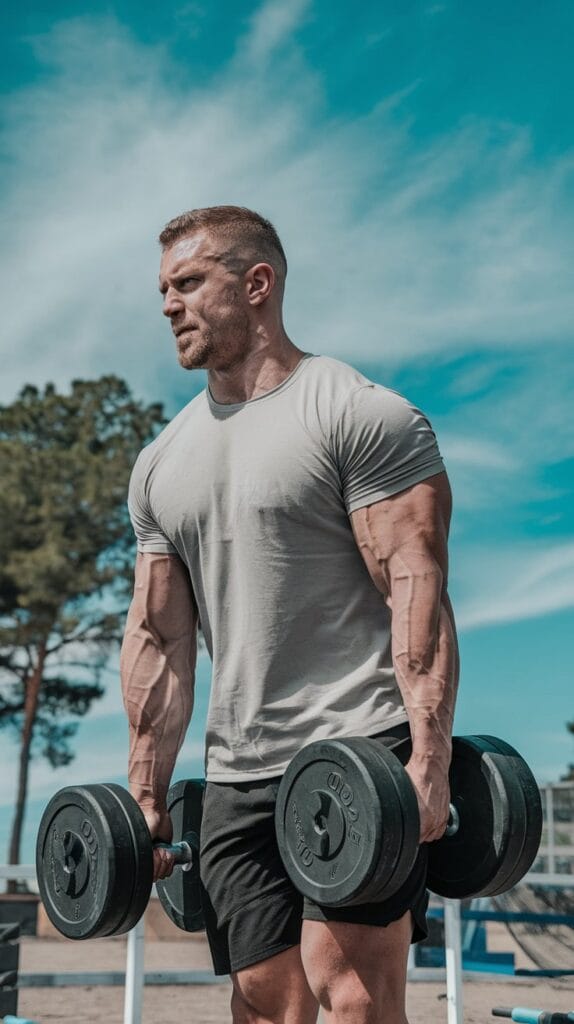
We have become obsessed with complicated gym machines and intricate hypertrophy splits, yet many people possess “gym strength” that fails them in the real world. You might be able to bench press an impressive weight, but do you struggle to carry all the groceries in one trip or feel your back ache after a few hours of yard work? This disconnect happens because most modern exercises isolate muscles rather than teaching them to work as a single, cohesive unit. This old-school strongman staple is the most functional movement in existence, yet it is often ignored in favor of flashy equipment.
The Farmer’s Carry is exactly what it sounds like: you pick up something heavy in each hand and walk. While it lacks the complexity of a snatch or the prestige of a heavy deadlift, it offers a “brute force” stimulus that few other moves can match. It forces your core to stabilize under a shifting load, crushes your grip strength, and rebuilds your posture from the ground up. If you want a “bulletproof” frame and functional power that actually translates to your daily life, it is time to stop overcomplicating your routine and start walking with weight.
Why the Farmer’s Carry Beats the Deadlift for Functionality
The deadlift is often called the “king of exercises,” and for good reason—it builds massive posterior chain strength. However, the deadlift is a static lift. Once you stand up with the bar, the movement is essentially over. In contrast, the Farmer’s Carry introduces the element of locomotion. Every step you take creates a “mini-stabilization” crisis for your joints. Your ankles, knees, hips, and spine must all micro-adjust to keep the weight from pulling you out of alignment.
This “dynamic stability” is what builds real-world athleticism. While the deadlift teaches you to pull, the Farmer’s Carry teaches you to hold and move. This is the missing link for many lifters who have reached a plateau in their core strength or find themselves dealing with nagging shoulder and lower back pain. By forcing your body to stay tall under a heavy load, you are essentially performing a “moving plank” that hits every muscle from your traps to your calves.
Farmer’s Carry vs. Deadlift
| Benefit | Farmer’s Carry | Deadlift |
| Grip Strength | Exceptional (Duration-based) | High (Peak-force based) |
| Core Stability | Anti-Lateral (Moving) | Anterior (Static) |
| Injury Risk | Very Low | Moderate to High |
| Posture Fix | Realigns Shoulders/Spine | Strengthens Posterior Chain |
| Technical Difficulty | Low (Anyone can walk) | High (Requires form coaching) |
The Hidden Benefits of “Heavy Walking”
Beyond just building muscle, the Farmer’s Carry offers unique physiological benefits that are often overlooked. First and foremost is the impact on your grip strength. Research consistently shows that grip strength is one of the most accurate predictors of long-term health and longevity. It correlates with cardiovascular health and even cognitive function. Because the Farmer’s Carry requires you to hold heavy loads for time, it builds the kind of forearm endurance that makes every other lift in the gym feel easier.
Secondly, the “loaded carry” is a miracle worker for shoulder health. Most people spend their days hunched over a keyboard, leading to internally rotated shoulders and a weak upper back. When you perform a Farmer’s Carry correctly, the weight pulls your shoulders down and back into a “packed” position. This activates the lower traps and the rotator cuff, creating a stable platform for the shoulder joint. Over time, this corrective tension can alleviate chronic shoulder impingement and improve your overhead pressing mechanics.
How to Perform the Perfect Farmer’s Carry
While the move is simple, it is not “easy.” Proper execution is the difference between building a bulletproof core and just straining your lower back.
- The Setup: Stand between two heavy dumbbells, kettlebells, or specialized Farmer’s walk handles.
- The Pick: Deadlift the weights up with a flat back. Do not “round” your spine to grab them.
- The Posture: Imagine a string pulling the crown of your head toward the ceiling. Pull your shoulder blades into your “back pockets.”
- The Walk: Take small, quick steps. Large strides create too much side-to-side sway, which can stress the sacroiliac (SI) joint.
- The Breathing: Do not hold your breath. Use “braced breathing”—keep your abs tight like someone is about to punch you, but take shallow, controlled breaths over the top of that tension.
5 Variations for Total-Body Transformation
Once you master the basic carry, you can utilize these variations to target specific weaknesses in your physique:
- The Suitcase Carry: Hold a weight in only one hand. This forces the opposite-side obliques to work overtime to keep you from leaning. It is arguably the best “hidden” core exercise in the gym.
- The Rack Carry: Hold kettlebells in the “front rack” position against your chest. This shifts the load to the front of your body, torching your upper back and abs.
- The Overhead Carry (Waiter’s Walk): Hold a weight directly overhead with a locked-out arm. This is the ultimate test of shoulder stability and mid-back strength.
- The Bottoms-Up Carry: Hold a kettlebell upside down. This forces your grip and rotator cuff to stabilize the weight so it doesn’t flip over.
- The Zercher Carry: Cradle the weight in the crooks of your elbows. This creates immense tension in the anterior core and biceps.
Programming the Farmer’s Carry
You don’t need a dedicated “carry day” to see results. Instead, treat the Farmer’s Carry as a “finisher” or a “filler” exercise.
Option A: The Finisher
At the end of your regular workout, pick up the heaviest dumbbells you can handle for 30 seconds. Walk for 30 seconds, rest for 60 seconds, and repeat for 4 to 5 rounds. Your heart rate will skyrocket, and your forearms will be on fire.
Option B: The “Super-Set” Filler
Pair your main lift with a carry. For example, after a set of bench presses, immediately perform a 40-yard Suitcase Carry. This keeps your heart rate elevated and ensures you are training your core and grip even on “upper body” days.
Option C: The Distance Challenge
Find a length of 50 yards. Pick a weight that represents roughly 50% of your body weight (total). Try to complete the 50 yards without dropping the weight. Once that becomes easy, increase the weight or the distance.
Related Articles
- Forget the Barbell: This “Bear Hug Squat” Builds Strength, Fixes Posture, and Adds Years to Your Life
- Is Couch-to-5K Too Hard? Try This Gentle 8‑Week Plan That Gets You to 5K in 2026
- Getting Weaker? 7 Hidden Signs Your Workout Is Doing More Harm Than Good
- The Strength Shortcut? This Odd “Static” Move Builds Muscle Without Lifting a Single Weight
- Too Tired to Exercise? These 3 Chair Yoga Poses Restore Strength & Calm (Perfect for Seniors)