FREE SHIPPING OVER $50
Protein Prodigy Review: Is This $120 Protein Worth It?

⚡ The 30-Second Verdict
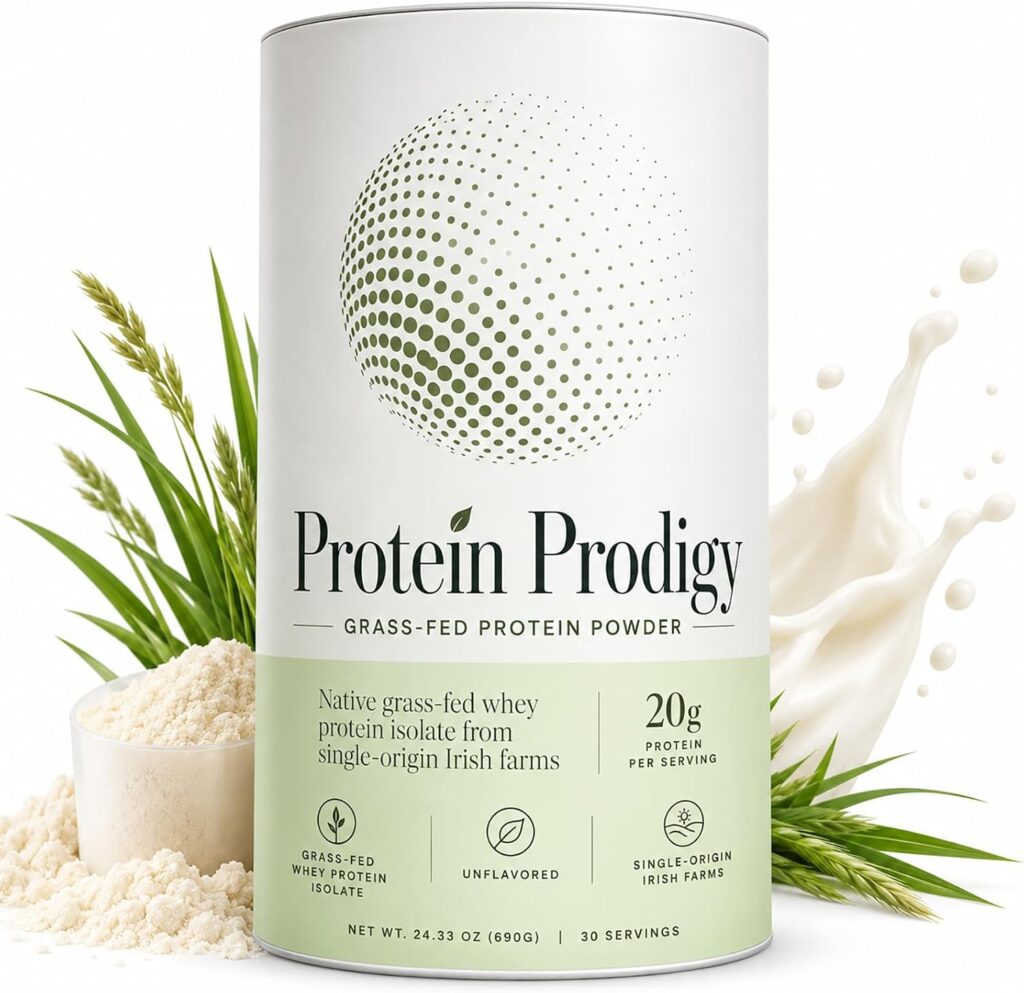
Protein Prodigy is a genuinely good whey isolate sold at a genuinely hard-to-justify price.
- What it is: A single-ingredient whey protein isolate from grass-fed Irish milk, filtered cold, with no sweeteners, flavours, or gums.
- What you get: 20g of complete protein per 23g serving, PDCAAS 1.0, 99% lactose-free.
- What it costs: Around $120 per tub, or roughly $3.30 per serving. Comparable whey isolates run $1.00–$1.50.
- Who it’s for: People who want protein that disappears into coffee, hate sweetened shakes, and will pay a premium for a two-ingredient label.
- Who should skip it: Anyone buying protein for muscle gain, post-workout recovery, or budget. A $40 tub does the same job.
Overall score: 3.2 / 5 — excellent product, poor value.
📊 Scorecard
| Category | Score | Why |
|---|---|---|
| Ingredients & purity | 4.5 / 5 | Two ingredients. No gums, sweeteners, or artificial flavours. Third-party tested for heavy metals. |
| Protein quality | 4.5 / 5 | PDCAAS 1.0, all nine essential amino acids, 10g leucine per 100g. |
| Mixability | 3.5 / 5 | Most buyers say it dissolves cleanly in coffee. A meaningful minority report clumps and sticking. |
| Taste | 4 / 5 | Neutral and lightly milky by design. If you want chocolate, this isn’t it. |
| Transparency | 3 / 5 | The label is honest. The marketing around “first-of-its-kind” filtration is not. |
| Value | 1.5 / 5 | $3.30 per serving is roughly double to triple the category average. |
What Protein Prodigy Actually Is
Strip away the branding and you’re looking at a whey protein isolate — the purest form of whey, filtered to remove most fat and lactose.
The full ingredient list is unusually short: whey protein isolate, plus less than 1% sunflower lecithin to help it disperse. No sucralose, no stevia, no xanthan gum, no “natural flavours.” That two-ingredient label is the product’s strongest genuine selling point.
Nutrition per 23g serving:
| Metric | Amount |
|---|---|
| Protein | 20g |
| Protein concentration | 87% |
| PDCAAS score | 1.0 (maximum) |
| Essential amino acids | All 9 |
| Leucine | 10g per 100g |
| Lactose | 99% lactose-free |
| Added sugar | 0g |
| Sweeteners / gums / flavours | None |
The protein itself comes from grass-fed Irish dairy cows, and the brand states it’s third-party tested for heavy metals and microplastics. It’s also positioned as suitable during pregnancy and breastfeeding, though the brand itself recommends checking with your doctor first.
On paper, this is a clean, high-quality isolate. There’s no nutritional argument against it.
The “First-of-Its-Kind” Claim: What’s True and What Isn’t
This is where the review gets less flattering.
Protein Prodigy is made using cold cross-flow microfiltration, which the brand describes as “first-of-its-kind”. The process is real, and it’s good — it separates protein from fat and lactose at low temperatures without chemicals, preserving the protein’s structure.
But it isn’t new. Cold cross-flow microfiltration has been used to make whey isolates for decades, and many major whey brands already use it. A nutrition analysis published by foodfacts.org puts it bluntly: the technology is legitimate, but presenting it as a novel breakthrough is difficult to justify.
The same applies to the coffee claim. Protein that dissolves into hot drinks is a genuinely nice feature — but it’s not a problem nobody else has solved. Several whey isolates and plant proteins already blend into coffee and porridge without ruining the texture.
And the “especially made for women” framing? Whey isolate doesn’t change its amino acid profile based on who buys it. One review argues this positioning is primarily branding rather than a meaningful nutritional distinction.
None of this makes the product bad. It makes the price harder to defend.
Does Protein Prodigy Actually Dissolve in Coffee?
This is the question most people are actually searching for, and the honest answer is: mostly yes, with caveats.
Positive verified reviews describe it as fine as flour, silky, and light enough that it “disappears into coffee” with no chalky aftertaste. Buyers also report it mixing well into oats and baking without a gritty texture.
But the complaints are consistent enough to matter:
- One reviewer said it eventually dissolved but required a lot of stirring and produced worrying lumps — and that it clumps and sticks when cleaning up.
- Another gave it four stars specifically because it “doesn’t mix super easily”.
Practical takeaway: if you’re stirring it into black coffee with a spoon, expect some effort. The brand ships a free electric frother with subscriptions for exactly this reason. Use it, or add the powder to a shaker first and pour the coffee in — not the other way round.
💸 The Cost Problem: $3.30 vs $1.20
Here’s the math that decides whether this product makes sense for you.
| Protein Prodigy | Standard Whey Isolate | |
|---|---|---|
| Tub price | ~$120 | $40–70 |
| Servings per tub | ~36 | 40–70 |
| Cost per serving | ~$3.30 | $1.00–$1.50 |
| Cost per 20g protein | ~$3.30 | ~$1.00–$1.20 |
| Annual cost (1 serving/day) | ~$1,200 | ~$400–550 |
That’s roughly $650–800 more per year for the same 20g of protein.
You are paying for: single-origin Irish milk, a two-ingredient label, cold filtration, third-party testing, and the convenience of coffee compatibility. Those are real things. Whether they’re worth an extra $2 per scoop is a personal call — but it’s worth naming clearly, because most reviews won’t.
The brand’s own answer to “why is it more expensive” is that you’re paying for sourcing and purity. That’s fair as far as it goes. It just doesn’t change the fact that the amino acids your muscles receive are identical.
Do You Even Need a Protein Powder?
This is the uncomfortable question underneath the entire category, and it’s worth answering honestly because it affects whether any protein powder is worth buying.
French nutrition experts reviewed the brand’s core claim — that most women are protein-deficient — and rejected it directly. According to INCA3 dietary survey data, French adults already consume about 1.2g of protein per kg of body weight daily, well above the 0.83g/kg official recommendation.
One dietitian quoted in Science & Vie was blunt: “Her discourse — that the majority of women lack protein — is false.” She went further on the marketing: “It’s marketing, clearly.”
The nuance matters, though. Protein powder is genuinely useful for specific people:
- Athletes and heavy lifters with high targets
- Older adults with poor appetite
- People in recovery or with restricted diets
- Anyone who genuinely can’t hit their target from food
It is not necessary for most healthy adults eating a varied diet. If that’s you, the honest advice is that a $120 tub won’t fix anything that eggs, Greek yogurt, fish, and lentils aren’t already fixing.
✅ Who Should Buy Protein Prodigy
- You drink coffee every morning and skip breakfast. This is the product’s actual use case, and it’s a good one. Two scoops turns a black coffee into a 20g protein start.
- You hate sweetened protein shakes. Most powders taste like dessert. This one tastes like milk.
- You have mild lactose sensitivity. At 99% lactose-free, it’s gentler than concentrate.
- You have a sensitive gut. No gums or sugar alcohols means less bloating for many people.
- You value a short ingredient list and are willing to pay for it.
❌ Who Should Skip It
- You want the best protein per dollar. Buy a mid-range isolate. Optimum Nutrition, Dymatize ISO100, and Ascent all deliver 24–25g per serving at a third of the cost.
- You’re buying for muscle gain. Once total daily protein is adequate, the source matters far less than training and consistency. A $40 tub is not a compromise here.
- You want a flavoured shake. This is unflavoured by design. You’ll be disappointed.
- You’re on a tight budget. There is no nutritional justification for the premium.
- You expect it to stir effortlessly into hot coffee with a spoon. Bring a frother or manage your expectations.
🥄 How to Use It (If You Buy It)
- Coffee or matcha: Two scoops, then froth. Adding powder to liquid works better than liquid to powder.
- Porridge or yogurt: Stir in after cooking, not during — heat degrades texture.
- Smoothies: Works, but you’re paying a premium for a use case where any whey isolate performs identically.
- Baking: Verified buyers report it bakes well without a gritty mouthfeel.
- Dose: Two scoops for 20g. One scoop gives you 10g, which is a small serving for the price.
❓ FAQs
Is Protein Prodigy worth $120?
Only if coffee convenience and a two-ingredient label are worth roughly $2 extra per serving to you. Nutritionally, cheaper isolates deliver the same 20–25g of complete protein. The product is good; the premium is the debate.
Does Protein Prodigy actually dissolve in coffee?
Mostly. The powder is very fine, and many verified buyers say it disappears cleanly. A notable minority report clumping and residue, especially when stirring by hand. Use the included frother.
Is Protein Prodigy better than regular whey?
It’s cleaner in formulation, not superior in effect. Both are complete proteins with all nine essential amino acids. Your body doesn’t distinguish between grass-fed Irish whey and a standard isolate once absorbed.
🏁 Bottom Line
Protein Prodigy is not a scam, and it’s not a miracle. It’s a well-made, genuinely clean whey isolate with a real convenience advantage for coffee drinkers — wrapped in marketing that oversells how novel it is.
Buy it if your actual problem is that you skip breakfast and want 20g of protein in the coffee you’re already drinking. That’s a real problem, and this solves it elegantly.
Skip it if you want protein for training, recovery, or general nutrition on a sensible budget. A $40 tub does the same job, and the extra $80 buys you a story more than a nutrient.
The best protein powder is the one you’ll actually use consistently. For some people, that’s this one. For most, it isn’t — and that’s worth saying out loud.
Related Articles
- We Tried 17 Protein Powders—These 7 Are Actually Worth Your Money
- Try These 5 High-Protein Smoothie Ingredients Instead of Protein Powder
- This High-Protein Snack Can Help Lower Your Cholesterol, Say Dietitians
- The Unexpected Ingredient I Added to My Eggs That Boosted My Protein Intake
- How to Get 100 Grams of Protein a Day Without Feeling Like a Gym Rat