FREE SHIPPING OVER $50

Falls Are the Silent Killer of Your Healthspan—Here’s How to Add 10 Years of Independent Living

Imagine working out diligently, eating a clean diet, and optimizing your sleep for decades, only to have your entire healthspan derailed in a single fraction of a second by an unexpected patch of ice or a loose rug. While most people in the longevity space spend all their time worrying about cholesterol numbers, blood sugar spikes, and cellular aging, they routinely ignore the single most immediate threat to their long-term independence: losing their balance. Statistically, an accidental trip is not just an embarrassing mishap; it is a foundational health event that often marks the definitive boundary between a vibrant, self-sufficient life and a rapid decline in physical capability.
The Hidden Threat to Your Longevity
To truly understand why balance matters, you must look at the crucial distinction between lifespan and healthspan. Lifespan is simply the total number of years you stay alive, whereas healthspan represents the number of years you remain healthy, functional, and completely free from chronic disease or debilitating disability. You can easily possess a long lifespan while suffering from a horribly compromised healthspan.
When you lose your physical independence, your overall quality of life plummets. Unfortunately, skeletal fractures caused by sudden drops are the primary catalyst for this loss of independence. Statistics from health organizations show that one out of every three adults over the age of 65 experiences a tumble every single year.
Worse yet, these incidents are responsible for the vast majority of hip fractures and traumatic brain injuries in older adults. By prioritizing your stability today, you can easily add an extra 10 years of autonomous, active living to your future self.
The Cascading Effect: Why a Single Slip Can Be Fatal
A serious injury rarely causes an immediate end to someone’s life on its own. Instead, it triggers a devastating, multi-system cascading failure that ravages the body over the span of several months. The true danger begins the moment a person is admitted to a hospital bed with a fractured hip or pelvis.
When an older adult becomes completely immobilized in a hospital bed, their body undergoes an incredibly rapid process called sarcopenia, which is the accelerated loss of skeletal muscle mass and strength. A week of strict bed rest can strip away pounds of lean muscle tissue from the lower body.
Beyond the physical destruction, the psychological toll is equally dangerous. After experiencing a painful accident, people naturally develop an intense fear of falling again. This psychological trauma causes them to drastically restrict their daily activities, avoid leaving the house, and stop exercising altogether.
The Three Pillars of Dynamic Balance
Maintaining your upright posture while moving through a complex world requires a complex, real-time calculation inside your nervous system. Your brain relies on three entirely separate physiological pillars to keep you steady on your feet.
- The Visual System: Your eyes constantly map out the horizon, calculating distances and identifying potential tripping hazards before your feet ever reach them.
- The Vestibular System: Located deep inside your inner ear, this network of fluid-filled canals acts as your body’s internal level, sending instantaneous data to your brain about head position, acceleration, and spatial orientation.
- The Somatosensory System (Proprioception): This network consists of specialized nerve receptors hidden within your muscles, tendons, and joints. These receptors act like microscopic sensors, telling your brain exactly where your limbs are positioned in space without you needing to look at them.
Testing Your Current Fall Risk
Before you can fix your stability, you need an accurate baseline measurement of your current balance capabilities. You do not need an expensive sports science laboratory to test your neural pathways. You can easily assess your neurological health using a simple, diagnostic tool called the Single-Leg Stance Test.
To perform this test safely, stand near a sturdy wall or kitchen counter that you can grab if you lose your footing. Lift one foot completely off the ground, start a timer, and see how long you can maintain your balance on a single leg without shifting your standing foot or touching the wall. Once you master that, try the exact same test with your eyes closed to see how much you rely purely on your vision.
The following data table outlines the target durations for healthy adults across various age brackets based on clinical longevity standards.
| Age Bracket | Target Duration (Eyes Open) | Target Duration (Eyes Closed) |
| Under 40 Years | 45 Seconds | 15 Seconds |
| 40 to 49 Years | 40 Seconds | 10 Seconds |
| 50 to 59 Years | 35 Seconds | 8 Seconds |
| 60 to 69 Years | 30 Seconds | 5 Seconds |
| Over 70 Years | 20 Seconds | 3 Seconds |
If your eyes-closed scores fall significantly below these metrics, your proprioceptive and vestibular systems are severely underperforming. This means your nervous system is missing the vital sensory inputs needed to keep you upright when environmental conditions change unexpectedly.
The Independent Living Blueprint
To fully safeguard your healthspan and add a decade of autonomous living to your timeline, you must adopt a multi-faceted approach to physical conditioning. Relying solely on standard cardio workouts like walking or cycling simply will not cut it.
Muscle Power Over Pure Strength
When you trip over an uneven sidewalk, your brain has less than half a second to fire your leg muscles, extend your foot, and plant it firmly on the ground to break your momentum. This lightning-fast reaction relies entirely on fast-twitch explosive muscle fibers.
To build this specific type of power, you need to incorporate eccentric training and velocity-based movements into your weekly routine. Eccentric exercises focus heavily on the lowering phase of a lift, teaching your muscles how to absorb massive force and decelerate your body weight safely.
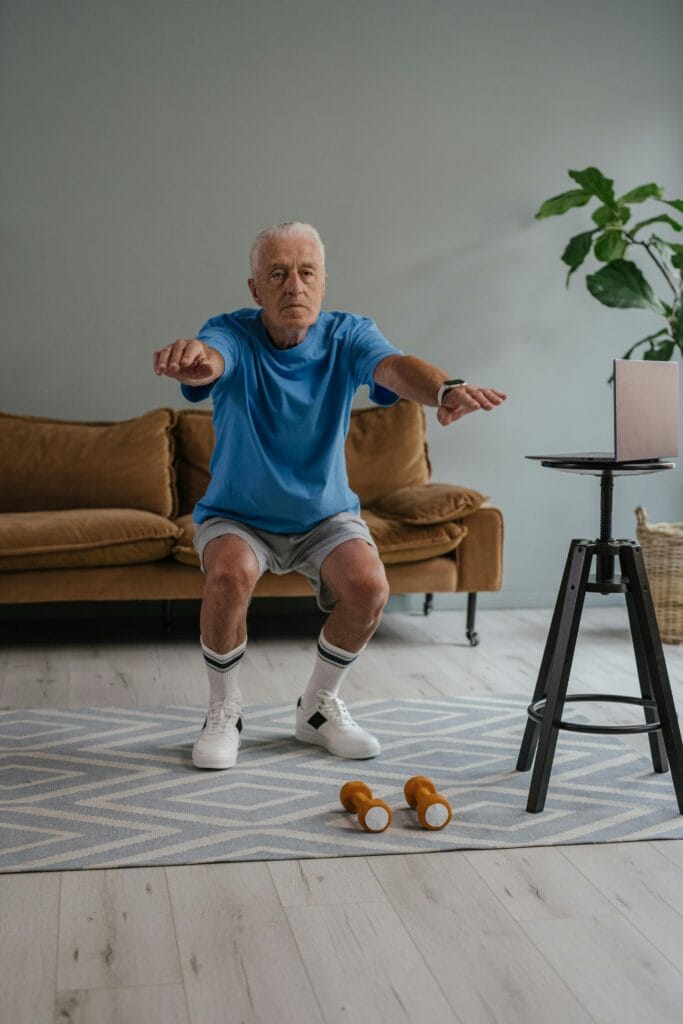
Practicing controlled, explosive movements like bodyweight box squats, kettlebell swings, and rapid step-ups teaches your nervous system to activate muscle fibers instantly when emergency stabilization is required.
Grip Strength and Upper Body Architecture
It may sound surprising, but your grip strength is one of the most accurate biological markers for overall longevity and fall survival. A weak grip generally indicates systemic muscle wasting throughout the entire skeletal system.
If you do experience a sudden drop, your upper body architecture serves as your final line of defense. Having strong shoulders, wrists, and arms allows you to execute a protective bracing maneuver, absorbing the impact of the ground and sparing your hips or skull from taking the direct hit.
You can easily build robust grip strength by doing simple carry variations like the farmer’s carry into your workouts. Pick up a pair of heavy dumbbells or kettlebells and walk slowly across a room for 60 seconds while keeping your posture perfectly straight.
Environmental Optimization
Taking a weekend to thoroughly audit your living space can dramatically reduce your daily baseline risk. Start by removing all loose throw rugs, securing loose electrical cords along walls, and adding high-lumens, motion-activated night lights to dimly lit walkways.
In the bathroom, install high-quality non-slip silicone mats inside the shower stall. These simple, inexpensive adjustments create a forgiving environment that complements your physical training.
The 10-Minute Daily Anti-Fall Routine
Building bulletproof stability does not require hours of exhausting gym sessions. Consistently practicing a concise sequence of daily stability drills will stimulate your neuroplasticity, building permanent, high-speed neural pathways between your feet and your brain.
1. Short-Foot Sensory Activation: 2 Minutes.
Stand completely barefoot on a hard floor. Spread your toes as wide as possible and press your big toe firmly into the ground. Attempt to lift the inner arch of your foot upward without curling your toes. This simple movement turns on the millions of proprioceptive receptors on the bottom of your feet, instantly priming your brain’s connection to the ground.
2. The Tandem Walk Challenge: 3 Minutes.
Place a long strip of painter’s tape on the floor or follow a straight seam in your flooring. Walk slowly along the line by placing the heel of your front foot directly against the toes of your back foot, exactly like walking a tightrope. To make this drill much harder, turn your head slowly from side to side or blink your eyes rhythmically while maintaining your forward momentum.
3. Perturbation Training: 3 Minutes.
Stand safely on one leg near a wall or counter. Hold a moderately heavy object, such as a medicine ball, a gallon of water, or a single dumbbell, close to your chest. Slowly move the weight in an unpredicted figure-eight pattern around your torso, or pass it quickly from hand to hand. This movement constantly shifts your center of mass, forcing your core and ankle stabilizers to make rapid micro-adjustments.
4. Eccentric Drop Landings: 2 Minutes.
Stand flat on both feet, quickly raise your body up onto your tiptoes, hold for one second, and then drop your heels back down into a soft, athletic partial squat position. Absorb the downward impact smoothly through your knees and hips without letting your torso tilt forward. This drill trains your lower body joints to properly dissipate sudden forces.
Related Articles
- I’m a Longevity Scientist—This Rare Deep-Sea Nutrient Lengthened My Telomeres and Dropped My Biological Age by 12 Years
- I’m a Neurologist and This Is the One Subtle Sign That Tells Me a Patient Might Be on the Dementia Path (Before Any Formal Diagnosis)
- Future-Proof Your Brain: The “Anti-Aging” Exercise Routine Doctors Recommend to STOP Dementia & Memory Loss
- Over 50? These 15 Foods Are Practically a Recipe for Dementia
- Turns Out My ‘Dementia’ Was Just a Vitamin Deficiency—And Fixing It Was So Simple