FREE SHIPPING OVER $50

8 Minutes Seated, Stronger for Months: The Chair Routine That Outperforms 30 Minutes of Weights After 50

If you have ever walked into a gym and felt overwhelmed by the rows of heavy iron and complicated machines, you are not alone. For many people over the age of 50, the traditional “no pain, no gain” approach to fitness starts to feel like a recipe for injury rather than a path to health. We are told that to stay strong, we need to lift heavy and spend hours under a barbell. But what if the most effective tool for your metabolism was sitting right in your living room?
It sounds like a bold claim, but new research into “functional density” suggests that an 8-minute seated routine can actually build more usable strength than 30 minutes of traditional weightlifting. By using a chair to isolate specific muscle groups and leverage time under tension, you can stimulate muscle growth without the joint-crushing impact of heavy weights.
Why Traditional Weightlifting Becomes “High Risk” After 50
To understand why a chair is so effective, we first have to look at why traditional weights often fail us as we age. After 50, our tendons and ligaments lose some of their elasticity. When you perform standing squats or overhead presses with heavy dumbbells, your joints often take the brunt of the load before your muscles even get a chance to work.
Furthermore, traditional lifting often relies on momentum. People swing weights or use their lower back to help finish a rep. In a chair, momentum is largely removed from the equation. You are forced to use pure muscular force to complete the movements. This transition from “lifting” to “controlling” is what triggers significant strength gains in a fraction of the time.
The Science of Seated Strength: How 8 Minutes Beats 30
You might be wondering how 8 minutes could possibly outperform a longer session. It comes down to a concept called Restricted Range Tension. When you are seated, your core must work overtime to keep your spine neutral because you don’t have your legs to balance your weight.
Additionally, seated exercises allow for “Isometric Overloading.” This is when you hold a muscle in a contracted position for a set amount of time. Research shows that these holds can recruit more motor units—the tiny bundles of nerves and muscle fibers—than a standard “up and down” repetition. By keeping your muscles under constant tension for 8 minutes straight, you create a metabolic stimulus that 30 minutes of “stop-and-start” lifting simply can’t match.
| Feature | 30 Minutes of Weights | 8-Minute Chair Routine |
| Joint Impact | High (Compression) | Very Low (Stability) |
| Muscle Activation | Variable (often uses momentum) | High (Isolates muscle groups) |
| Cortisol Spike | High (Longer sessions) | Low (Short duration) |
| Recovery Time | 48-72 hours | 24 hours |
| Core Engagement | Moderate | Constant (due to seated posture) |
The 8-Minute Chair Routine Breakdown
This routine is designed to be done three times a week. You don’t need fancy equipment—just a sturdy, armless chair (avoid anything with wheels). Perform each movement for 60 seconds, focusing on slow, deliberate control.
1. The Seated March (Core and Hip Flexors)
Sit at the very edge of your chair with your back straight and your hands lightly gripping the seat. Lift one knee toward your chest as high as possible, hold for two seconds, and slowly lower it. Alternate legs. This builds the deep core strength necessary for balance and walking.
2. The Invisible Press (Shoulders and Upper Back)
Extend your arms out to your sides at shoulder height, elbows bent at 90 degrees (like a goalpost). Slowly press your hands toward the ceiling without letting your shoulders “shrug” up toward your ears. The key here is to squeeze your shoulder blades together throughout the entire minute.
3. Seated Leg Extensions (Quadriceps and Knee Health)
While seated, slowly straighten one leg until it is parallel to the floor. Flex your toes back toward your shin and squeeze your thigh muscle as hard as you can for five seconds. Lower slowly. This is the single best move for protecting the knee joint from “creaky” pain.
4. The Seated “Good Morning” (Lower Back and Hamstrings)
Cross your arms over your chest. Keeping your back perfectly flat, hinge forward from your hips as if you are trying to touch your nose to the wall in front of you. Once you feel a stretch in your hamstrings, use your lower back muscles to pull yourself back to an upright position.
5. Tricep Chair Dips (Arm Strength and Posture)
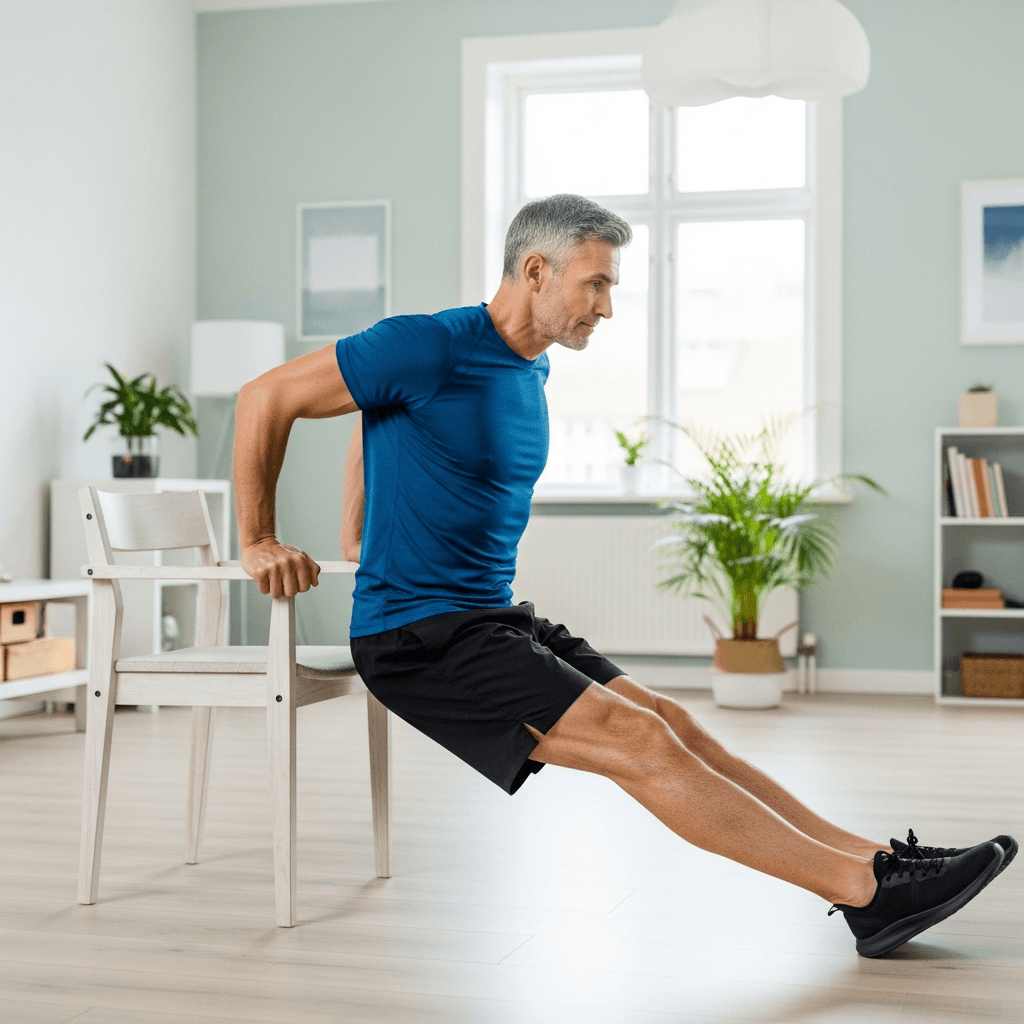
Place your hands on the edge of the seat next to your hips. Scoot your bottom off the chair, supporting your weight with your arms. Bend your elbows slightly and then press back up. Even a small range of motion here will transform the “batwing” area of the arms.
Improving Mobility While Building Power
Most people think of strength and flexibility as two different things. However, in a chair routine, they are one and the same. Because you are working through a controlled, seated range of motion, you are naturally “stretching” the opposing muscle groups.
For example, when you perform the Seated Good Morning, you are strengthening your lower back while simultaneously lengthening your hamstrings. This dual-action approach is why people who follow this routine report feeling “looser” and more mobile within just a few weeks. It turns out that a strong muscle is a flexible muscle.
How to Stay Consistent
The beauty of the 8-minute routine is that it removes the “I don’t have time” excuse. You can do this while watching the evening news, waiting for your coffee to brew, or during a commercial break. To see the best results:
- Focus on the Squeeze: The harder you contract the muscle, the better the result. Don’t just go through the motions.
- Breathe Deeply: Never hold your breath. Exhale during the “hard” part of the move to keep your blood pressure stable.
- Progress Slowly: If 60 seconds feels easy, try to slow down your movements even further. Speed is the enemy of seated strength.
Related Articles
- Getting Weaker? 7 Hidden Signs Your Workout Is Doing More Harm Than Good
- The Strength Shortcut? This Odd “Static” Move Builds Muscle Without Lifting a Single Weight
- Too Tired to Exercise? These 3 Chair Yoga Poses Restore Strength & Calm (Perfect for Seniors)
- He’s 63, Ripped, and Defying Aging. What He Told Me About Muscles Blew My Mind—You Need to Hear This
- 10 Effortless Daily Habits That Keep Your Body Attractive Without Ever Stepping Into a Gym