FREE SHIPPING OVER $50

The Squat Variation That Builds Cyclist-Level Quads—and Why Most Lifters Never Add It to Their Routine


If you have ever looked at the massive, tree-trunk thighs of a professional track cyclist and wondered why your heavy back squats aren’t yielding the same “teardrop” definition, you are likely a victim of your own biomechanics. Most traditional lifting advice tells you to “sit back into your hips” and keep your shins as vertical as possible to protect your knees, but this very cue is exactly what is stealing your quad gains. By shifting the load into your hips, you turn the squat into a posterior-chain dominant movement, effectively letting your glutes and lower back do the heavy lifting while your quads just tag along for the ride. Making a tiny, two-inch adjustment to your foot position forces your knees to travel forward and puts your quadriceps under a level of mechanical tension that a standard squat simply cannot replicate.
The Anatomy of the “Teardrop”: Understanding the VMO
To build legs like a cyclist, you have to target the Vastus Medialis Obliquus (VMO), commonly known as the “teardrop” muscle located just above the knee. While the other three muscles of the quadriceps are involved in knee extension, the VMO is specifically responsible for the final stages of that extension and for stabilizing the kneecap.
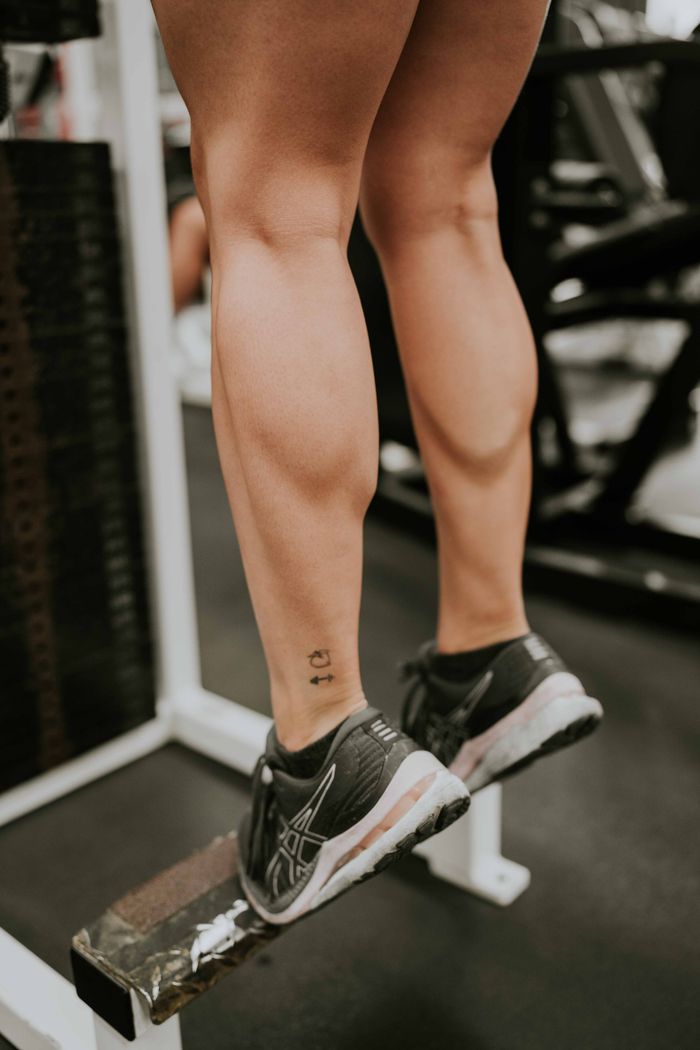
Cyclists develop massive VMOs because their sport involves thousands of repetitions of knee-dominant force. When you are on a bike, your torso stays relatively upright while your knees drive forward and down. In the gym, we can replicate this specific stress by elevating the heels. This shift in center of gravity allows the knees to track significantly further forward than they could on flat ground, which stretches the quadriceps under load and forces the VMO to take over the lion’s share of the work.
Why Most Lifters Are Afraid of the “Forward Knee”
For decades, the fitness industry has operated under the myth that “knees over toes” is a recipe for orthopedic disaster. Consequently, most lifters have been conditioned to fear knee travel, opting instead for a “hip-hinge” style squat that protects the knees but neglects the quads.
However, modern sports science has largely debunked this fear for healthy individuals. When you avoid forward knee travel, you aren’t necessarily “saving” your knees; you are simply transferring the force to your lower back and hips. By embracing the heels-elevated position, you are actually training your knees to handle stress in a controlled, stable environment. This builds the connective tissue strength in the patellar tendon that eventually makes your knees feel better during daily life and sports.
The Mechanical Leverage Audit: Flat vs. Elevated
The difference between a standard squat and a cyclist-level quad builder comes down to leverage. When you elevate your heels, you change the “moment arm” of the exercise, making the knee the primary axis of rotation rather than the hip.
The Squat Mechanics Comparison
| Feature | Standard Back Squat | Heels-Elevated “Cyclist” Squat |
| Primary Driver | Glutes and Hamstrings | Quadriceps (specifically VMO) |
| Shin Angle | Vertical / Neutral | Significant Forward Travel |
| Torso Position | Lean Forward (Hinged) | Upright / Vertical |
| Lumbar Stress | High (Shearing Force) | Low (Compressive Force) |
| Quad Recruitment | Moderate | Maximum |
How to Execute the 2-Inch Adjustment
You don’t need fancy equipment to start building cyclist quads. You can achieve this variation by placing a pair of 5-pound weight plates under your heels or by using a dedicated “slant board.”
- The Setup: Place your heels on a 1-to-2 inch elevation. Your feet should be roughly shoulder-width apart, with toes pointed slightly outward.
- The Descent: Instead of sitting “back,” think about sitting “down” between your ankles. Allow your knees to track forward over your toes as far as your mobility allows.
- The Depth: Aim for the “hamstrings to calves” position. The deeper the squat, the more the VMO is recruited at the bottom of the movement.
- The Ascent: Drive through the balls of your feet, keeping your torso upright. Avoid the “stripper squat” mistake where your hips rise faster than your shoulders.
The Anabolic Stretch: Why Deep Squats Win
One of the primary drivers of muscle growth is Stretch-Mediated Hypertrophy. This occurs when a muscle is forced to produce force while in a fully lengthened position. In a standard squat, many lifters stop at “parallel,” which means the quads never actually reach full extension under load.
By elevating the heels and allowing the knees to travel forward, you achieve a much deeper “knee flexion” (bend). This puts the quadriceps—especially the rectus femoris—into a massive stretch. When you drive out of that deep “hole,” you are triggering a survival response in the muscle fibers that forces them to grow thicker and stronger to handle the tension. This is why cyclists, who spend hours in deep knee flexion, have such dense leg musculature compared to the average gym-goer.
Overcoming the Mobility Barrier
The reason many lifters never add this to their routine is that they simply can’t do it comfortably. Lack of ankle mobility (dorsiflexion) is the number one reason people lean too far forward in a squat. When your ankles are stiff, your heels want to pop off the ground as you go lower.
Elevating the heels is essentially an “anatomical cheat code” that bypasses poor ankle mobility. It allows you to maintain a vertical spine and get deep into the squat even if your calves are tight. However, this shouldn’t be a permanent crutch. While you use the heels-elevated variation to build your quads, you should also be working on your ankle flexibility through daily stretching and soft tissue work.
Programming for Explosive Quad Growth
If you want to see results, you cannot treat the heels-elevated squat like a secondary “finisher.” It needs to be a cornerstone of your leg day. Because this variation places a high demand on the knee joint, it is often better to use slightly higher repetition ranges than you would for a max-effort back squat.
- The Hypertrophy Protocol: 3 to 4 sets of 10 to 15 repetitions.
- The Tempo: Use a controlled 3-second descent (eccentric) to maximize the “Anabolic Stretch.”
- The Frequency: Add this to your routine twice a week. Once as a primary lift (Barbell Heels-Elevated Squat) and once as an accessory (Goblet Heels-Elevated Squat).
Managing the Load and Recovery
Because your torso stays more upright in this variation, you will find that your lower back is much less of a limiting factor. This is a double-edged sword; it means you can push your quads much closer to failure, but it also means the local fatigue in the legs will be much higher.
Expect significant “DOMS” (Delayed Onset Muscle Soreness) in your quads for the first few weeks. To manage this, ensure you are prioritizing recovery through Zone 2 cardio—which, ironically, is what cyclists do for hours. This low-intensity movement helps flush the legs of metabolic waste and speeds up the repair of the muscle fibers you just decimated with your new squat technique.
Related Articles
- Why the 2-2-2 Training Protocol Is the Secret to Building Muscle Without Destroying Your Joints After 40 and 50
- A Personal Trainer’s Way to Return to Exercise in Your 40s and 50s — That Has Nothing to Do With How You Trained Before
- My 78-Year-Old Yoga Instructor Moves Better Than Most 40-Year-Olds — She Credits These 5 Daily Moves for Everything
- Stop Feeling “Rusty”: The 5-Minute Mobility Routine That Keeps Your Hips and Back Fluid After 50
- Scientists Just Identified the One Exercise That Protects Your Brain Better Than Swimming or Cycling — and Most People Are Already Ignoring It