FREE SHIPPING OVER $50
He’s 75 But His Cells Are 40: The 3 “Impossible” Habits That Reversed His Biological Age


We have all seen that one person at the gym or the grocery store who seems to defy the laws of physics. They have the silver hair of a grandfather, but the stride, skin, and energy of someone in their late thirties. Usually, we shrug it off as “good genetics” and go back to our coffee, but science is starting to prove that genetics only accounts for about 20 percent of how we age. The rest is dictated by our environment and the specific signals we send to our cells every single day. When I sat down with a man we will call Arthur—a 75-year-old whose recent epigenetic test clocked his biological age at exactly 40.2 years—I expected to hear about expensive boutique supplements or secret blood transfusions. Instead, he shared a blueprint of lifestyle choices that sound nearly impossible to the average person living in a world of modern convenience.
Arthur’s results aren’t just a fluke or a mistake in the lab. He uses the Horvath Clock, a biochemical test that measures DNA methylation levels to determine how fast your “internal clock” is ticking. While his birth certificate says 1950, his internal cellular machinery is performing like a man born in 1985. This 35-year gap is the result of what he calls “Hormetic Precision.” He hasn’t just lived a healthy life; he has systematically challenged his body to stay in a state of constant repair. By moving away from the “Comfort Trap” of modern society, he has forced his cells to remain in a youthful, resilient state. Here is exactly how he did it through three specific, high-impact habits that most people find too difficult to even try.
The Science of Biological Age vs. Chronological Age
To understand Arthur’s transformation, we have to look at what is happening inside the nucleus of the cell. Every cell in your body has a “biological age” that is separate from the date on your ID. This age is determined by your epigenome—the system of “switches” that turn your genes on or off. As we age, these switches get cluttered with “epigenetic noise.” Think of it like a pristine record that gets scratched over time until the music becomes distorted. DNA methylation is the process of adding methyl groups to your DNA, which acts as a marker for these scratches.
When a lab tests your biological age, they are looking at these methylation patterns. A “young” cell has very specific patterns that allow it to repair DNA, produce energy efficiently, and clear out waste. An “old” cell is sluggish and prone to error. Arthur’s 35-year age reversal means he has successfully “cleaned” the scratches off his epigenetic record. He has tricked his body into thinking it is still in its prime, which triggers the production of youthful proteins and enzymes that most 75-year-olds have long since stopped producing.
Habit 1: Chronic Hormetic Stress (The Thermal Shock)
The first “impossible” habit Arthur swears by is a grueling daily routine of thermal shock. Most of us spend our lives between 68 and 74 degrees Fahrenheit, never allowing our bodies to feel truly hot or truly cold. Arthur believes this thermal comfort is a “longevity killer.” Every morning, he starts his day with a three-minute plunge into a 45-degree ice bath, immediately followed by twenty minutes in a 180-degree sauna. This isn’t just a test of willpower; it is a calculated biological strike.
When you submerge yourself in freezing water, your body releases “Cold Shock Proteins,” specifically one called RBM3. Research from the University of Cambridge has suggested that these proteins can actually rebuild the synapses in the brain and prevent the loss of neurons. Furthermore, the extreme cold triggers the activation of brown fat, which incinerates white fat to create heat. Transitioning immediately to the sauna then triggers “Heat Shock Proteins” (HSPs). These proteins act like a cellular “quality control” team, refolding misfolded proteins that would otherwise clump together and cause diseases like Alzheimer’s or Parkinson’s. By putting his body through this thermal wringer every day, Arthur keeps his cellular repair mechanisms on high alert.
Habit 2: Metabolic Switching and Deep Autophagy
Arthur doesn’t follow a “diet” in the traditional sense; he follows a metabolic protocol. Most Americans eat from the moment they wake up until the moment they go to sleep, keeping their insulin levels elevated for 16 hours a day. Arthur does the opposite. He practices a “5:2 Metabolic Switch.” For five days a week, he eats within a tight six-hour window. For the other two days, he performs a full 24-hour water fast. To the average person, going a full day without food sounds like torture, but for Arthur, it is the secret to cellular recycling.
During these extended fasting periods, his body enters a state of deep autophagy. Autophagy literally translates to “self-eating,” and it is the process which your cells identify damaged mitochondria and broken proteins, break them down, and use the parts to build new, healthy structures. When we eat constantly, the body is always in “growth mode” (driven by a pathway called mTOR). Growth is great when you are a child, but in an adult, constant growth leads to cancer and accelerated aging. By fasting, Arthur flips the switch to “repair mode” (driven by the AMPK pathway). This metabolic flexibility is why his insulin sensitivity is that of an elite athlete, allowing his cells to process energy without the inflammatory damage that typically ages the human body.
Habit 3: High-Intensity Structural Load
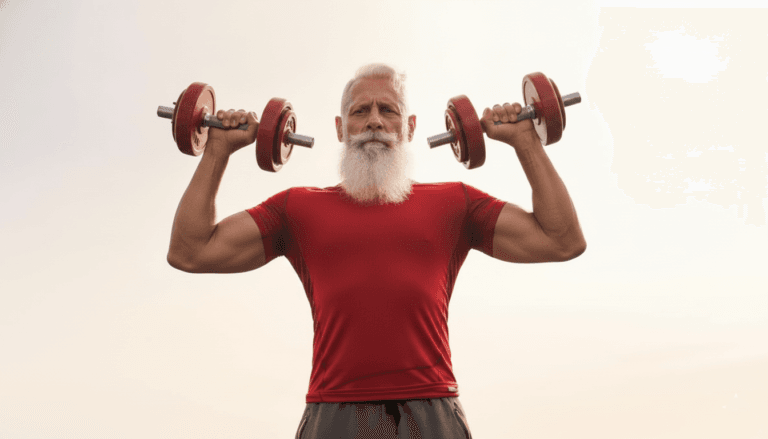
The third habit that reversed Arthur’s age is his approach to movement. He doesn’t do “cardio” in the way most seniors do. You won’t find him on a slow walk around the neighborhood. Instead, he focuses on what he calls “Structural Load”—heavy, compound resistance training and high-intensity interval sprints. He lifts weights that most men half his age would find intimidating. He understands a vital truth of longevity: muscle is more than just for show; it is a “longevity organ.”
Muscle tissue produces myokines, which are signaling molecules that communicate with the brain, liver, and immune system to reduce inflammation. By maintaining a high level of muscle mass, Arthur has created a metabolic “buffer.” His muscles soak up excess glucose, preventing the glycation that causes skin wrinkles and arterial stiffness. Furthermore, his high-intensity sprints trigger a massive release of Human Growth Hormone (HGH) and testosterone naturally. While most men his age see their hormone levels crater, Arthur’s body is still getting the signal that it needs to stay strong and “useful.” The “impossible” part isn’t the lifting itself; it is the intensity. He trains with a ferocity that forces his bones to stay dense and his nervous system to stay sharp.
The Role of Telomeres in the 35-Year Gap
One of the most impressive markers of Arthur’s health is his telomere length. Telomeres are the protective caps on the ends of your chromosomes, similar to the plastic tips on shoelaces. Every time a cell divides, the telomeres get a little shorter. When they get too short, the cell can no longer divide and becomes a “senescent” or “zombie” cell, secreting inflammation and aging the cells around it.
Because of his habits—specifically the combination of fasting and intense exercise—Arthur has high levels of an enzyme called telomerase, which helps maintain and even lengthen these protective caps. While the average 75-year-old has telomeres that are dangerously short, Arthur’s look like those of a man in his early 40s. This means his cells have a much higher “division limit” remaining, effectively giving him more time before his tissues start to break down. This is the physical reality of “turning back time”; it is a literal lengthening of your biological fuse.
The Psychological Shift: Embracing Discomfort
You might be wondering how someone maintains these “impossible” habits for decades. When I asked Arthur about his motivation, he didn’t talk about wanting to live to 150. He talked about “The Comfort Trap.” He believes that the more comfortable your life is, the faster you die. Our ancestors evolved in a world of extreme cold, intermittent hunger, and constant physical demand. Our DNA expects us to be challenged.
When we remove those challenges—when we stay at 72 degrees, eat three meals a day, and sit in cushioned chairs—our bodies assume that the “struggle” is over and it is time to shut down. Arthur’s secret is that he intentionally reintroduces that struggle. He sees the ice bath as a reset for his brain and the heavy weights as a reminder to his bones that they are still needed. This psychological shift from “seeking comfort” to “seeking challenge” is the foundation upon which all his biological results are built. It is a casual, daily defiance of the modern world.
Conclusion
Arthur’s story proves that the “biological time machine” isn’t a science fiction fantasy; it is a byproduct of how we treat our cells. By embracing hormetic stress, mastering metabolic switching, and maintaining structural load, he has successfully closed a 35-year gap between his birth date and his biological age. You don’t have to start with a 45-degree ice bath or a 24-hour fast to see results. The journey toward longevity begins with a single decision to step out of your comfort zone. Whether you choose to shorten your eating window or turn the shower to cold for thirty seconds, you are sending a signal to your telomeres and the epigenetic clock that you aren’t done yet. Stop letting the calendar dictate your health and start giving your cells a reason to stay young.
Related Articles
- Neurologist Warning: 1 in 3 Adults are Starving Their Brains of the ONE Vitamin That Prevents Cognitive Decline
- Neurologist Reveals: The 3 Simple ‘Brain-Flex’ Routines That Erase Loneliness and Boost Cognitive Health After 60
- The Hidden Cause of Weak Knees After 50—And the Natural Fix Doctors Want You to Know
- The #1 Exercise Strategy for Managing PCOS—And Why Most Women Do It Wrong
- Struggling With Balance? This 1 Daily Habit Could Keep You Steady for Life