FREE SHIPPING OVER $50
Forget the Barbell: This “Bear Hug Squat” Builds Strength, Fixes Posture, and Adds Years to Your Life

For decades, the barbell back squat has been hailed as the undisputed king of leg exercises. If you wanted to build serious strength, you were told to put a heavy metal bar across your shoulders and start descending. However, for many people—especially those dealing with lower back sensitivity or a “desk-job” posture—the back squat can feel more like a liability than an asset. The weight sits behind your center of gravity, often forcing your torso to lean forward and putting massive shear force on your lumbar spine.
What if there was a variation that provided all the muscle-building benefits of the squat while actually correcting your posture and protecting your back? Enter the Bear Hug Squat.
By shifting the weight from your back to the front of your body, you change the physics of the movement. This “anterior loading” acts as a counterweight, allowing you to sit deeper, keep your spine upright, and engage your core in a way that a barbell simply can’t replicate. It is a functional powerhouse that translates directly to real-world longevity.
The Biomechanics of Anterior Loading
To understand why the Bear Hug Squat is so effective, we have to look at how your nervous system responds to weight. When you hold a heavy sandbag, a medicine ball, or even a large bag of groceries against your chest, your brain receives a signal to “stiffen” the core. This is a reflexive stabilization.
Because the weight is trying to pull you forward, your erector spinae (the muscles running along your spine) and your deep abdominal wall must work together to keep you upright. This creates a “natural weight belt” effect. Unlike the back squat, which can crush you into a rounded position, the Bear Hug Squat pulls you into better alignment.
| Feature | Barbell Back Squat | Bear Hug Squat |
| Weight Position | Posterior (Behind shoulders) | Anterior (Against chest) |
| Spinal Stress | High (Compressive/Shear) | Low (Decompressive effect) |
| Core Engagement | Moderate | Extreme (Reflexive) |
| Accessibility | Requires high mobility | Beginner-friendly |
Why the Bear Hug Squat is a “Longevity Lift”
Longevity isn’t just about how many years you live; it is about your “functional healthspan.” One of the strongest predictors of all-cause mortality as we age is the Sit-to-Stand Test. This measures your ability to move your own body weight from a seated position without assistance.
The Bear Hug Squat is the ultimate training tool for this test. It builds “functional” leg strength that mimics how we actually move in real life—picking up a grandchild, carrying a heavy box, or getting out of a low car. By strengthening the quads, glutes, and core simultaneously, you are building a physical insurance policy against the frailty that often comes with aging.
Furthermore, because this move requires significant upper-back strength to hold the weight, it fights “kyphosis”—the age-related rounding of the shoulders. When you hold a heavy object in a bear hug, you are forced to retract your shoulder blades and extend your thoracic spine. You are literally training your body to stand tall.
How to Perform the Bear Hug Squat Correctly
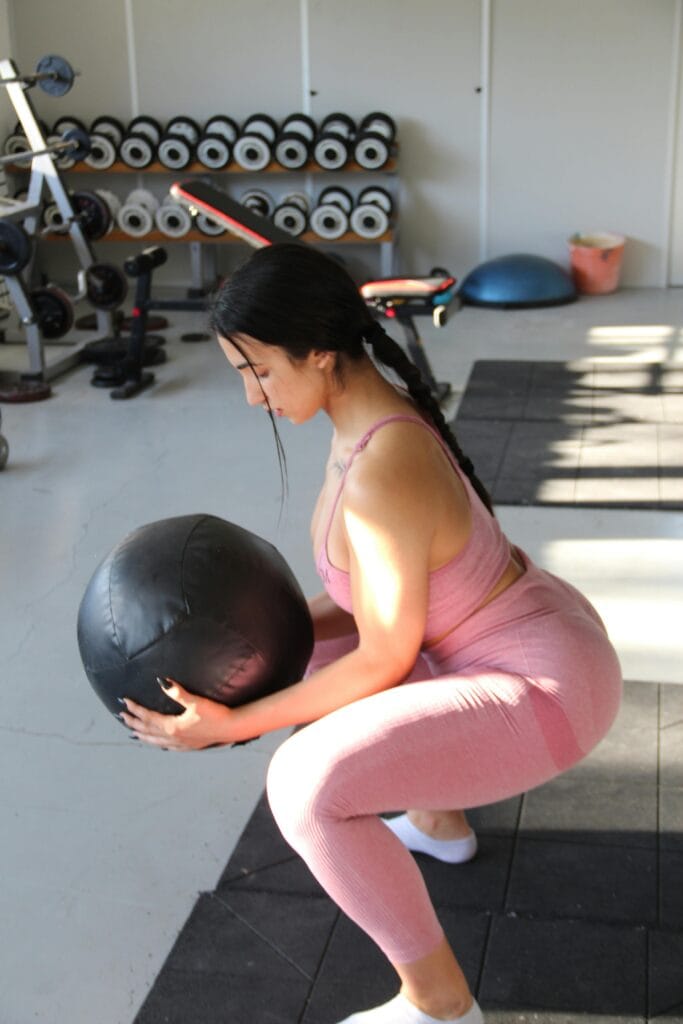
You don’t need a squat rack for this move, which makes it perfect for home gyms or crowded commercial spaces. You can use a sandbag, a heavy medicine ball, or even a single heavy dumbbell held vertically.
- The Grip: Wrap your arms around the object as if you are giving it a literal bear hug. Squeeze it tight against your chest. This “active” hold is what engages the lats and core.
- The Stance: Set your feet slightly wider than shoulder-width with your toes pointed slightly out.
- The Descent: Take a deep breath into your belly. Sit your hips back and down, keeping the weight glued to your chest. Your elbows should stay inside your knees as you reach the bottom.
- The Drive: Push through your mid-foot and heels to return to a standing position. Squeeze your glutes hard at the top.
Fixing the “Desk-Worker” Posture
Modern life has most of us stuck in a “C-shape.” We sit at desks, lean over steering wheels, and stare at phones. This weakens the muscles of the mid-back and tightens the hip flexors.
The Bear Hug Squat acts as a daily “reset” for this damage. The weight in front of your body forces your mid-back (the thoracic spine) to work in opposition to the load. Over time, this builds the endurance of the postural muscles, making it easier to sit and stand with a neutral spine.
Additionally, because the anterior load allows for a more upright torso, you can achieve a deeper range of motion in the hips. This deep squatting “stretches” the hip flexors and ankles, reversing the stiffness caused by chronic sitting.
Metabolic Demand: More Bang for Your Buck
If your goal is fat loss or metabolic health, the Bear Hug Squat is superior to many isolation exercises. Holding a heavy weight against your chest while squatting creates a massive demand on your cardiovascular system.
Your heart has to work twice as hard to pump blood to your legs while your upper body is under a constant isometric load. Transitioning from a standard leg press to Bear Hug Squats can significantly increase your caloric burn and improve your “work capacity.” This makes it an ideal movement for those who want to get “sculpted” in a short amount of time.
Sample “Unbreakable Spine” Routine
To reap the benefits, you don’t need to do this every day. Incorporating it twice a week into your existing routine is plenty for most people.
- Frequency: 2 times per week.
- Sets/Reps: 3 to 4 sets of 8–12 reps.
- Focus: Control the 3-second descent. Pause for 1 second at the bottom to maximize the postural correction.
By focusing on the “tempo” rather than just the weight, you increase the time under tension for your core and upper back. This is what builds that “steel-like” stability that protects you from injury during daily tasks.
Related Articles
- Is Couch-to-5K Too Hard? Try This Gentle 8‑Week Plan That Gets You to 5K in 2026
- Getting Weaker? 7 Hidden Signs Your Workout Is Doing More Harm Than Good
- The Strength Shortcut? This Odd “Static” Move Builds Muscle Without Lifting a Single Weight
- Too Tired to Exercise? These 3 Chair Yoga Poses Restore Strength & Calm (Perfect for Seniors)
- He’s 63, Ripped, and Defying Aging. What He Told Me About Muscles Blew My Mind—You Need to Hear This