FREE SHIPPING OVER $50
8 Stability Ball Exercises That Build More Core Strength Than 500 Crunches

If you are still grinding through hundreds of repetitive floor crunches every single workout, you are likely wasting your time while needlessly straining your neck and lower back. Traditional floor crunches only work a small portion of your front abdominal wall through a tiny range of motion, whereas training on an unstable surface forces your entire 360-degree core—including your deep transverse abdominis, internal obliques, and lower back stabilizers—to fire constantly just to keep you balanced. Research in exercise biomechanics consistently shows that instability training activates significantly more muscle fibers than static floor exercises, meaning a few focused stability ball movements will build a stronger, more athletic midsection in a fraction of the time.
Biomechanical research reveals that performing abdominal exercises on a stability ball can increase muscle activation in your core by up to 249% compared to traditional floor crunches.
Why Traditional Crunches Fail Your Core
Most gym-goers assume that feeling a burn during a crunch translates to building high-level core strength. However, floor crunches primarily isolate the rectus abdominis—the superficial “six-pack” muscle—while ignoring the deeper muscular layers that stabilize your spine and pelvis.
Furthermore, doing endless crunches forces your spine into repetitive flexion. Over time, this constant forward bending can compress lumbar disks and tighten your hip flexors, leading to poor posture and nagging lower back pain.
When you lie on a flat floor, your body relies on the rigid surface for support. Consequently, your deep core muscles do not need to work very hard to keep you upright.
In contrast, a stability ball (often called a Swiss ball or physio ball) introduces controlled instability. Because the ball constantly shifts beneath you, your brain instantly recruits stabilizing muscles to maintain balance. As a result, every movement becomes a full-core challenge that protects your spine while sculpting your midsection.
The Science: How Instability Triggers Maximum Muscle Activation
Electromyography (EMG) studies measure the electrical activity inside muscles during exercise. When sports scientists compared standard floor crunches to stability ball exercises, the results were eye-opening.
A landmark study conducted at San Diego State University evaluated popular core movements and discovered that stability ball exercises ranked among the highest for recruiting both the upper and lower rectus abdominis, as well as the obliques.
Training on an unstable sphere offers three distinct advantages:
- Greater Range of Motion: The rounded surface allows your spine to safely extend backward beyond parallel, stretching your abdominal muscles before they contract.
- Continuous Muscle Tension: Your muscles remain under tension throughout the entire rep because you must fight gravity and instability simultaneously.
- Deep Muscle Recruitment: The instability engages the transverse abdominis—the deep internal muscle that acts as your body’s natural corset or weight belt.
8 Stability Ball Exercises That Outperform Floor Crunches
1. The Stability Ball Rollout
The rollout is widely regarded by strength coaches as the single best core exercise for anti-extension strength. It forces your abs to resist arching in your lower back as your arms move away from your body.
How to do it:
- Kneel on a soft mat with your forearms resting on a stability ball in front of you.
- Engage your core, squeeze your glutes, and slowly roll the ball forward until your body forms a straight line from knees to shoulders.
- Pause for a second at full extension, then press your forearms into the ball to pull yourself back to the starting position.
Keep your lower back flat throughout the movement. Avoid letting your hips sag toward the floor.
2. The Stability Ball Pike
The pike is an advanced movement that targets your lower abs, shoulders, and deep stabilizers while building functional upper-body power.
How to do it:
- Start in a high plank position with your shins resting on top of the stability ball and your hands directly beneath your shoulders.
- Keeping your legs straight, lift your hips toward the ceiling by pulling the ball toward your chest with your feet.
- Pause at the top when your body forms an inverted “V” shape, then slowly lower your hips back into a control plank.
Focus on pushing the floor away with your hands to keep your shoulders fully engaged.
3. Stability Ball Stir-the-Pot
Popularized by world-renowned spine biomechanist Dr. Stuart McGill, “Stir-the-Pot” combines a plank with dynamic arm rotation, creating multi-directional instability that destroys deep core fibers.
How to do it:
- Place your forearms on the ball and step your feet back into a wide plank stance.
- Maintain a rigid plank while slowly making small circular motions with your forearms as if stirring a giant pot.
- Perform several rotations clockwise, then reverse direction and rotate counter-clockwise.
Keep your hips completely still. The only moving parts should be your forearms on the ball.
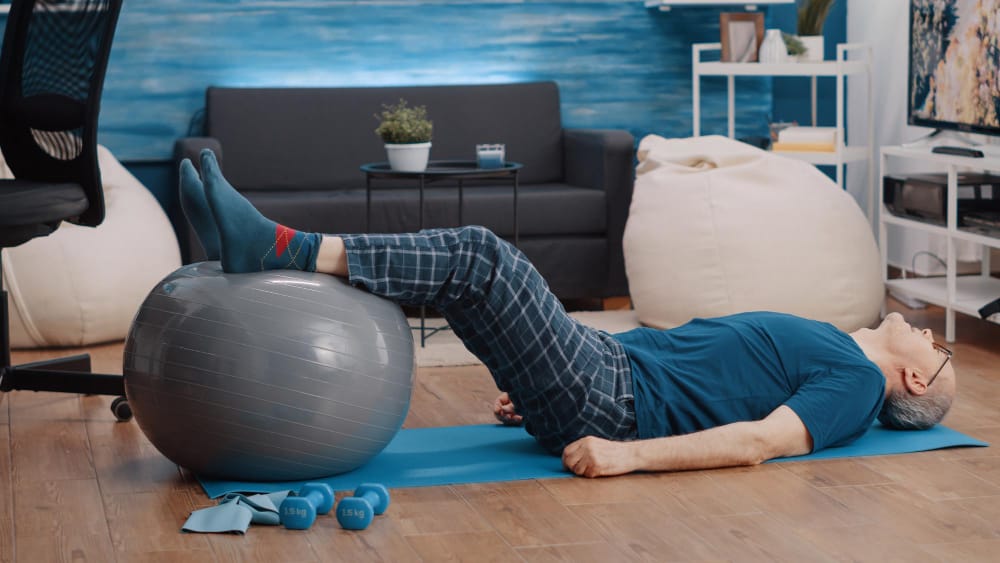
4. Stability Ball Hamstring Curl and Bridge
While many people treat this as a leg movement, holding a bridge on an unstable ball severely challenges your lower back, glutes, and posterior core stabilizers.
How to do it:
- Lie flat on your back with your arms resting at your sides and your heels resting on top of the ball.
- Press your heels into the ball and lift your hips until your body forms a straight line from shoulders to ankles.
- Bend your knees to pull the ball toward your glutes, hold for a second, then extend your legs back out without letting your hips drop.
Squeeze your glutes tightly at the top of each rep to keep your lower back supported.
5. Stability Ball Jackknife
The jackknife resembles the pike, but bending your knees makes it slightly easier to control while focusing intensely on lower abdominal contraction.
How to do it:
- Assume a push-up position with your shoelaces resting on the ball and hands firmly on the floor.
- Draw your knees toward your chest, rolling the ball forward as your lower abs contract.
- Pause for a beat, then extend your legs straight back out into a crisp plank position.
Inhale as you extend your legs and exhale as you drive your knees toward your torso.
6. Stability Ball Wall Squat with Core Twist
Adding a medicine ball or torso rotation to a wall squat turns a lower-body exercise into an integrated rotational core challenge.
How to do it:
- Place the stability ball between your lower back and a smooth wall, standing with feet shoulder-width apart.
- Lower yourself into a squat until your thighs are parallel to the ground.
- Hold the squat position while holding a lightweight plate or ball in front of you, rotating your torso smoothly to the right and then to the left.
This isometric hold builds incredible endurance in your legs while forcing your obliques to control the rotational forces.
7. Stability Ball Pass-Through
This dynamic movement acts as a weighted deadbug progression, requiring perfect coordination between your upper and lower abdominal regions.
How to do it:
- Lie on your back holding the stability ball above your chest with both hands, legs extended straight out.
- Simultaneously raise your arms and legs to meet in the middle, transferring the ball from your hands to between your ankles.
- Lower your arms and legs back toward the floor while gripping the ball firmly between your ankles.
- Reverse the motion on the next rep, passing the ball back from your feet to your hands.
Never let your lower back arch off the floor as your limbs lower toward the ground.
8. Stability Ball Decline Plank
Planks are great, but placing your feet on an elevated, rolling surface increases the gravitational load on your core and shoulders.
How to do it:
- Place your toes on top of the stability ball and walk your hands out into a high plank position.
- Hold your body in a dead straight line from head to heels, bracing your core as if preparing for a punch.
- Hold this static position for 30 to 45 seconds while breathing smoothly.
If your lower back starts to dip, immediately drop your knees to avoid straining your spine.
Floor Crunches vs. Stability Ball Core Training
| Feature | Traditional Floor Crunches | Stability Ball Core Training |
| Primary Muscles Worked | Upper Rectus Abdominis | Full Core (Abs, Obliques, Lower Back, Deep Stabilizers) |
| Range of Motion | Limited (Spinal Flexion Only) | Full Range (Extension + Flexion) |
| Spinal Pressure | High Compression on Lumbar Disks | Low Disparity / Natural Alignment |
| Balance & Stability | Low (Floor Provides Total Support) | High (Requires Constant Neuromuscular Adjustment) |
| Time Efficiency | Low (Requires Hundreds of Reps) | High (Maximum Fatigue in 8–12 Quality Reps) |
How to Structure Your Stability Ball Workout
You do not need to perform all eight exercises in a single session to see dramatic improvements in core strength. Instead, pick three or four movements and perform them as a circuit twice a week.
Follow this simple framework for maximum core strength gains:
- Frequency: Perform core workouts 2 to 3 times per week on non-consecutive days.
- Sets and Reps: Complete 3 sets of 8 to 12 controlled reps for dynamic movements (like Rollouts and Pikes).
- Hold Times: Complete 3 sets of 30 to 45 seconds for static holds (like the Decline Plank or Stir-the-Pot).
- Rest Intervals: Rest for 45 to 60 seconds between sets to allow your nervous system to recover fully.
Focus on slow, controlled movements rather than rushing through reps. Quality always beats quantity when training on an unstable surface.
Related Articles
- Forget Hour-Long Workouts: This 30-Minute, 6-Exercise Routine Is All You Need for Full-Body Results, Says a Top Trainer
- The Kettlebell Secret That’s Making Fast Runners Even Faster
- Out of Shape and Overwhelmed? This Simple Workout Plan Will Change Everything
- 5 Daily Exercises That Double Grip Strength and Reverse Aging
- Your Chest Day Is Broken: 5 Exercises Experts Beg You to Stop Doing Immediately