FREE SHIPPING OVER $50

How I Fixed My Backache by Strengthening Weak Hip Flexors — 4 Simple Exercises That Work

If you spend most of your day sitting at a desk only to head to the gym and “stretch out” your tight back, you might be accidentally fueling the very fire you are trying to extinguish. For years, I treated my nagging lower back pain as a spinal issue, but the breakthrough came when I realized my back wasn’t actually weak—it was exhausted from doing the job of my “sleepy” hip flexors. When your hip flexors, specifically the psoas and iliacus, lack the strength to stabilize your pelvis, your lower back muscles have to step in as a secondary stabilizer. This constant overwork leads to chronic tightness and that familiar, dull ache that never seems to go away with stretching alone. By shifting my focus from “stretching the tight” to “strengthening the weak,” I managed to flip my biological safety switch and restore my body’s natural alignment, proving that a resilient back actually starts at the hips.
The Psoas Paradox: Why Your Hips Are the “Hidden” Culprit
To understand why hip strength is the ultimate back-pain solution, we have to look at the unique anatomy of the psoas major. This is the only muscle in the human body that connects your upper body to your lower body. It originates on your lumbar vertebrae (your lower back) and attaches to the top of your femur (thigh bone). Because of this direct connection, the psoas acts as a bridge; when it is strong and active, it pulls the spine into a stable, neutral position.
However, a lifetime of sitting causes these muscles to become “functionally weak.” They aren’t just tight; they have lost their ability to generate force. Consequently, your pelvis tips forward into an Anterior Pelvic Tilt (APT). In this tilted position, the vertebrae in your lower back are compressed, and the muscles surrounding them have to stay “on” 24/7 just to keep you upright. Strengthening the hip flexors allows them to take that load back, effectively decompressing your spine from the inside out.
The Misconception: Why Stretching Isn’t Saving You
Most people with backache instinctively reach for their toes or pull their knees to their chest. While this feels good for about ten minutes, it rarely provides a permanent fix. This is because “tightness” is often a protective response from the nervous system. If your brain perceives that your hips are too weak to protect the spine, it will make the surrounding muscles feel “tight” to create a muscular splint.
When you stretch a tight muscle due to weakness, you are essentially removing the only stability your spine has left. This is why many people find their back pain worsens after a long yoga session or a series of deep stretches. Transitioning to a Strengthening Protocol signals to your brain that the “structural bridge” is now secure, allowing the protective tightness in your back to finally release.
The 4-Move “Structural Reset” Protocol
These exercises are designed to target the hip flexors in their shortened and lengthened positions, ensuring “Deep Stability” across your entire range of motion. Perform this circuit three times a week for the best results.
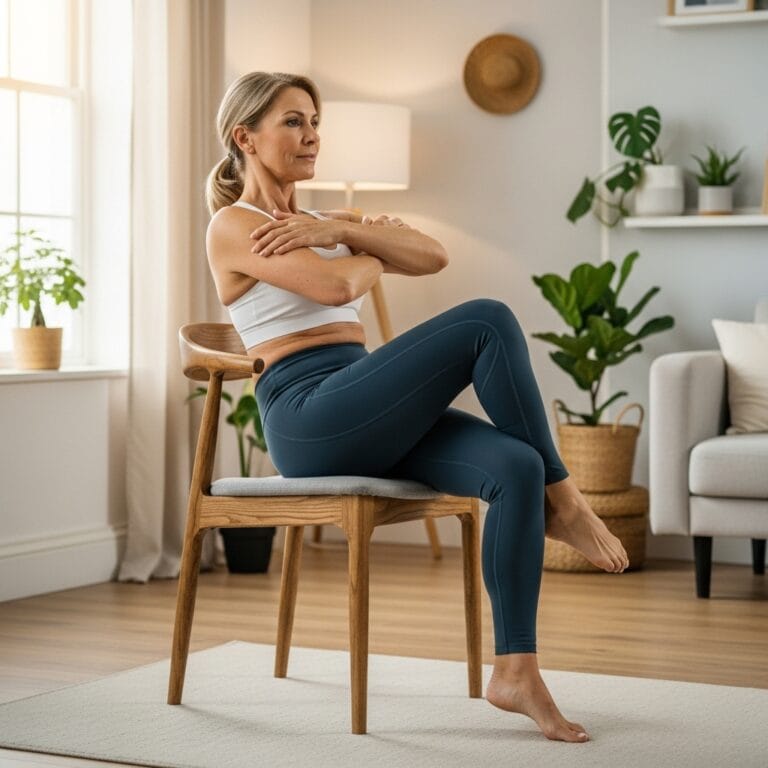
1. The Seated Psoas Lift
Sit on the edge of a chair or a bench with your back perfectly straight. Without leaning back, lift one knee toward your chest as high as you can while keeping your foot flexed. Hold the top position for 3 seconds, then lower slowly.
- Why it works: This isolates the hip flexor at the “end-range,” which is exactly where most people are the weakest.
2. The Supine Psoas March
Lie on your back with a small resistance band looped around your feet. Keep your lower back pressed firmly into the floor (no arching). Pull one knee toward your chest while pushing the other leg straight out.
- Why it works: This forces the hip flexors to work in tandem with the deep core (transverse abdominis), training your body to stabilize the pelvis during movement.
3. Standing Hip Flexor “Isos”
Stand on one leg and lift the other knee until your thigh is parallel to the ground. Use your hand to push down on your knee while your hip flexors “fight” to keep the leg up. Hold this isometric tension for 10 to 15 seconds.
- Why it works: Isometric holds build “Neurological Density,” teaching your brain how to recruit more muscle fibers in the hip area.
4. The Rear-Foot Elevated Split Squat (Focus on the Back Leg)
Place one foot behind you on a bench or couch and drop into a lunge. Instead of focusing on the front leg, focus on squeezing the glute of the back leg.
- Why it works: This strengthens the hip flexor in a “lengthened” state, which is crucial for maintaining a neutral pelvis while walking or running.
Restoring “Lumbopelvic Rhythm”
When your hip flexors are strong, you regain what kinesiologists call Lumbopelvic Rhythm. This is the synchronized movement between your hips and your lower back. In a healthy body, the hips should handle the majority of the movement during tasks like bending over, sitting down, or picking up a heavy bag.
When the hips are weak, that rhythm is broken, and the lower back is forced to do the “bending.” Over time, this repetitive micro-trauma leads to disc wear and muscle strains. By implementing these four exercises, you are effectively “re-syncing” your body’s gears. You’ll notice that basic movements start to feel “lighter” because the force is being distributed across the powerful muscles of the hip rather than the sensitive joints of the spine.
The Role of “Gluteal Synergy”
You cannot talk about hip flexor strength without mentioning the glutes. The glutes and the hip flexors are “antagonistic” muscles, meaning they work in a seesaw fashion. If your hip flexors are weak and “turned off,” your glutes often become inhibited as well. This is the “Double Whammy” of back pain: no support from the front and no power from the back.
As you strengthen the hip flexors through this protocol, you will likely find that your glute exercises (like squats or bridges) actually become more effective. This is because a stable pelvis provides a solid anchor for the glutes to pull against. This “Synergy” is the secret to a pain-proof body. You aren’t just fixing a “backache”; you are rebuilding the entire engine of your lower body.
Tips for Success: Quality Over Repetition
Because the psoas is a deep muscle, it is very easy to “cheat” these exercises by using your quads or arching your back. To ensure you are hitting the right target, keep these three cues in mind:
- Ribs Down: Keep your ribcage “knitted” toward your belly button. If your ribs flare up, you are likely arching your back and bypassing the hip flexors.
- Exhale on Effort: Breathe out forcefully as you lift your leg. This engages the deep core and provides a stable base for the psoas to pull against.
- No Leaning: If you have to lean back to lift your leg, the weight is too heavy or you are lifting too high. It is better to lift two inches with a straight back than ten inches with a lean.
Related Articles
- I Started Lifting Weights at 50 With No Experience — Here’s the Full Routine That Built Genuine Strength by 60
- 75 Years Old, 30-Year-Old Joints: The “Anti-Rust” Protocol That Beats Weight Machines Every Time
- The 15-Minute Muscle Hack: Build Total Body Power and a “Bulletproof” Core with Just 2 Dumbbells
- 5 Kettlebell Exercises a Kinesiologist Swears Will Make You Move Better at Any Level
- Stop Wasting Reps: A Personal Trainer’s 10 Underrated Exercises for Faster Muscle Growth