FREE SHIPPING OVER $50

A Top Pilates Instructor Calls These the Best Exercises for Undoing What a Desk Job Does to Your Body — and the Results Speak for Themselves

If you are reading this while hunched over a laptop or squinting at a smartphone, your spine is currently losing a battle against gravity that it wasn’t designed to fight. Sitting for eight hours a day isn’t just “inactive”—it is a high-tension physical event that actively reshapes your fascia, shortens your hip flexors, and puts your glutes into a state of “sleep mode” known as gluteal amnesia. Top Pilates instructors are moving away from traditional stretching and toward “Structural Decompression,” a method that focuses on re-stacking the vertebrae and hydrating the connective tissue that becomes brittle from lack of movement. The goal isn’t just to “feel better” after a long shift; it is to perform a biological reset that prevents the permanent postural aging that has become the hallmark of the modern workforce.
The Anatomy of the “Desk Slump”
To fix the damage, you have to understand exactly what sitting does to your internal scaffolding. When you sit, your pelvis tilts, your hamstrings tighten, and your core goes offline. This creates a “Crossed Syndrome” where the front of your body (chest and hips) becomes overactive and tight, while the back of your body (upper back and glutes) becomes weak and overstretched.
Pilates is uniquely suited to fix this because it emphasizes Eccentric Loading—strengthening a muscle while it is lengthening. Most people try to fix a desk job by “crunching” their back or stretching their hamstrings, but Pilates instructors argue that you actually need to decompress the joints first to allow the muscles to return to their optimal length.
The Desk Job Damage Report
| Affected Area | What Happens During Sitting | The Pilates Solution |
| Cervical Spine | “Forward Head Posture” (Tech Neck) | Axial Elongation (Spinal Growth) |
| Thoracic Spine | Kyphosis (Rounded Upper Back) | Extension & Rotation Exercises |
| Hip Flexors | Chronic Shortening & Tightness | Dynamic Psoas Lengthening |
| Glutes | Neural Inhibition (Dormancy) | Posterior Chain Activation |
| Diaphragm | Compressed (Shallow Breathing) | Lateral Ribcage Expansion |
Why “Passive” Stretching Isn’t Enough
Most office workers try to solve their back pain with a quick 30-second hamstring stretch. Unfortunately, your fascia—the cling-wrap-like tissue that surrounds your muscles—requires sustained, mindful movement to change its shape. Passive stretching often just pulls on the tendons without addressing the underlying “stiffness” in the muscle belly.
Pilates uses “controlled resistance” to tell your nervous system that it is safe to let go of that tension. By moving through a full range of motion while maintaining a stable core, you are essentially “un-sticking” the layers of tissue that have fused together from hours of stillness.
The “Anti-Desk” Big Five: Your Daily Reset
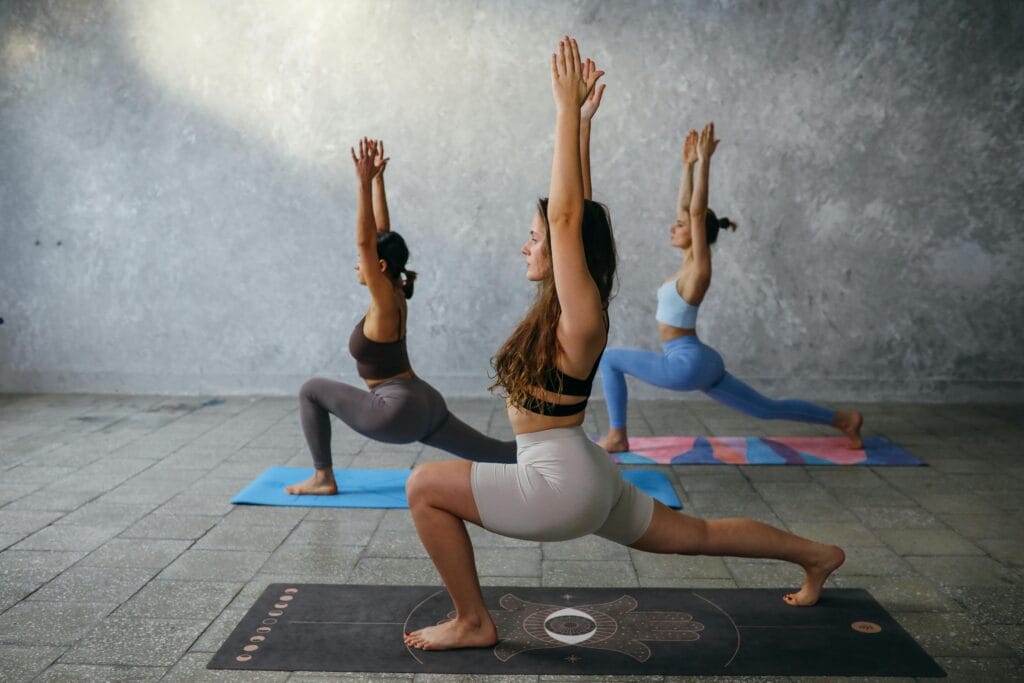
These five moves are the gold standard for undoing the “sitting signature.” They focus on opening the front line of the body while waking up the back line.
1. The Chest Opener Stretch (The Shoulder Opener)
Stand tall with your arms by your sides. Inhale as you reach your arms back behind your hips, opening your chest and pulling your shoulder blades together. Hold your breath for a second, look right, look left, and exhale as you return to center. This move specifically targets the pectoralis minor, the muscle that pulls your shoulders forward when you type.
2. The Cobra Pose (The Spinal Decompressor)
Lie on your stomach with your hands under your shoulders. Gently press into your palms to lift your chest off the floor, keeping your lower ribs in contact with the mat. This creates “extension” in the upper back—the direct opposite of the “hunch” you maintain at your desk. It re-hydrates the discs in your thoracic spine and wakes up the spinal extensors.
3. The Pelvic Tilt to Bridge (The Glute Wake-Up)
Lie on your back with your knees bent. Instead of just lifting your hips, focus on “peeling” your spine off the mat one vertebra at a time. This articulation keeps the spine supple. Once at the top, squeeze your glutes hard. This forces the tight hip flexors on the front to relax through a process called reciprocal inhibition.
4. The Saw (The Rotational Reset)
Sit with your legs wide and arms extended. Rotate your torso and reach your pinky finger toward your opposite pinky toe. Sitting often “locks” our ribs into a forward-facing position. Rotation is the first thing we lose as we age, and “The Saw” helps keep your obliques and intercostal muscles elastic.
5. The Wall Roll-Down (The Gravity Reversal)
Stand with your back against a wall and your feet a few inches away. Slowly roll your spine down toward the floor, imagining each vertebra leaving the wall one by one. Let your arms hang heavy like “dead weight.” This uses gravity to pull the tension out of your neck and lower back, providing an instant feeling of “space” in the joints.
The Breath Connection: Re-Oxygenating the System
One of the most overlooked side effects of desk work is “apnea” or shallow breathing. When you hunch, your lungs can’t fully expand, leading to lower oxygen levels and increased brain fog. Pilates instructors focus on Lateral Breathing—expanding the ribcage out to the sides rather than just pushing the belly out.
By practicing deep, lateral breaths during these exercises, you are physically pushing against the “stiff” connective tissue around your lungs. This increases your lung capacity and helps flush out the cortisol that builds up during high-stress work hours.
How to Implement “Micro-Resets” Throughout the Day
You don’t need a full hour on a Pilates Reformer to see the results. The “Results Speak for Themselves” because the body responds incredibly well to frequent, short bursts of movement. Instructors recommend the “50/5 Rule”: for every 50 minutes you spend sitting, perform 5 minutes of structural movement.
- 10:00 AM: Two minutes of Chest Expansion at your desk.
- 12:00 PM: Five minutes of Wall Roll-Downs before lunch.
- 3:00 PM: Three minutes of seated spinal rotation (The Saw) in your chair.
- 6:00 PM: A full “Swan” and “Bridge” sequence once you get home to signal to your body that the workday is over.
The Long-Term Results: Beyond the Back Pain
When you consistently apply these “Anti-Desk” moves, the results go beyond a lack of pain. You will notice an increase in Proprioception—your brain’s ability to sense your posture without looking in a mirror. You will find yourself naturally sitting taller, breathing deeper, and moving with more grace.
Dermatologists and physical therapists also note that “Postural Youth” leads to better circulation in the face and neck, reducing the appearance of “tech neck” lines and puffiness. By maintaining the “Space” in your joints, you are essentially preventing the compressed, shortened look that we traditionally associate with getting older.
Related Articles
- I Quit Squats and Lunges for 30 Days and Did This One Pilates Move Instead — My Glutes, Core, and Lower Back Have Never Felt Better
- The Upper Chest Most Lifters Never Fully Develop — and the Bodybuilder Trick That Finally Fixes It
- Low Volume, Max Results: Why the 30-10-30 Method is the Ultimate Muscle Hack You Need to Try
- The Forgotten King of Strength: One Simple Workout for Total-Body Power (That Isn’t the Deadlift)
- Forget the Barbell: This “Bear Hug Squat” Builds Strength, Fixes Posture, and Adds Years to Your Life