FREE SHIPPING OVER $50

Train Your Chest, Back, and Arms In Your Living Room With These 4 Beginner-Friendly Exercises

For many of us, the hardest part of starting a fitness journey isn’t the actual workout. It is the friction of getting to the gym. Between the commute, the monthly fees, and the intimidation of standing next to a powerlifter, it is easy to see why so many people quit before they even start.
However, your living room is actually a world-class training facility if you know how to use it. You don’t need a rack of shiny dumbbells or a $2,000 cable machine to see real changes in your physique. To build a powerful upper body, you only need to master a few fundamental movement patterns that target your chest, back, and arms simultaneously.
The Secret to Home Training Success
Before diving into the movements, it is important to understand how muscle growth works. Your muscles don’t know if you are in a fancy gym or next to your coffee table. They only respond to tension. Consequently, as long as you provide enough resistance to challenge your muscles, they will adapt by getting stronger and firmer.
Many beginners make the mistake of doing too many different exercises. Instead, you should focus on quality over quantity. By perfecting these four moves, you ensure that every major muscle group in your upper body is being hit effectively. This minimalist approach prevents burnout and makes it much easier to stay consistent.
4 Beginner-Friendly Upper Body Exercises
1. The Standard Push-Up (Chest, Shoulders, and Triceps)
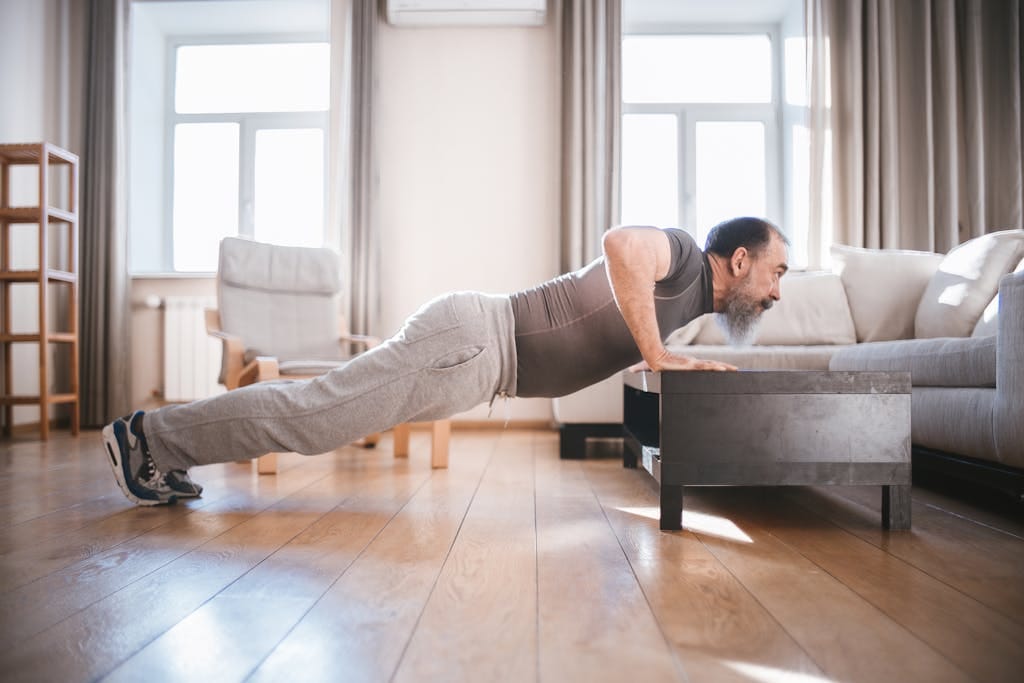
The push-up is the undisputed king of upper body bodyweight exercises. It primarily targets your pectorals (chest), but it also recruits your anterior deltoids (shoulders) and triceps (the back of your arms). Furthermore, a proper push-up acts as a “moving plank,” meaning your core has to work hard to keep your body straight.
To perform a perfect push-up, place your hands slightly wider than shoulder-width apart. Your body should form a straight line from your head to your heels. As you lower yourself, keep your elbows tucked at a 45-degree angle rather than flaring them out to the sides. This protects your shoulder joints and puts the maximum tension on your chest.
| Variation | Difficulty | Primary Focus |
|---|---|---|
| Incline Push-Up | Easy | Lower Chest / Beginner friendly |
| Knee Push-Up | Moderate | Chest Isolation |
| Standard Push-Up | Intermediate | Full Upper Body / Core |
| Diamond Push-Up | Hard | Triceps Focus |
2. The Inverted Row (Back and Biceps)
If the push-up is the ultimate “push” move, the row is the ultimate “pull” move. Training your back is essential for good posture and for creating a balanced look. Most beginners skip back training at home because they think they need a pull-up bar. However, you can easily train your back using a sturdy table or even a couple of chairs and a broomstick.
To perform an inverted row, lie underneath a sturdy table (or 2 chairs) and grip the edge. Keep your body straight and pull your chest toward the table, squeezing your shoulder blades together at the top. This move hits your rhomboids, lats, and the “pulling” muscles in your arms (your biceps).
3. The Pike Push-Up (Shoulders and Upper Triceps)
While standard push-ups hit the chest, the Pike Push-Up shifts the focus upward to your shoulders (deltoids). Having strong shoulders creates a wider frame and makes everyday tasks—like lifting a heavy box onto a shelf—much easier.
To get into the pike position, start in a standard push-up stance and walk your feet toward your hands until your hips are high in the air, forming an “A” shape. Lower the top of your head toward the floor in front of your hands, then push back up. This vertical pushing motion mimics an overhead press you would do with dumbbells in a gym.
4. The Plank-to-Push-Up (Arms, Core, and Stamina)
This final exercise is a dynamic move that bridges the gap between strength and endurance. It is one of the best ways to target your “arm definition” while simultaneously torching calories. It requires no equipment and very little space, making it perfect for a living room session.
Start in a forearm plank position with your weight on your elbows. One at a time, place your hands where your elbows were and push yourself up into a high plank (the top of a push-up). Then, lower yourself back down to your elbows one arm at a time.
How to Structure Your Home Routine
Consistency is the most important factor in any fitness program. You don’t need to train every day to see results. In fact, training three times a week is often better for beginners because it allows your muscles time to recover and grow.
- Frequency: 3 days per week (e.g., Monday, Wednesday, Friday).
- Sets: 3 sets per exercise.
- Reps: Aim for 8 to 12 reps per set. If you can’t hit 8, use an easier variation. If you can easily do 15, move to a harder variation.
- Rest: 60 to 90 seconds between sets.
By following this structure, you create a predictable environment for your body to change. Transitioning from one exercise to the next with minimal rest will also keep your heart rate elevated, providing a nice cardiovascular boost alongside your strength gains.
The Power of Progressive Overload
The biggest reason people stop seeing results at home is that they stop challenging themselves. Once your body gets used to 10 push-ups, it has no reason to get stronger. This is where Progressive Overload comes in.
To keep progressing, you must find ways to make the exercises harder over time. You don’t need weights to do this. You can slow down the tempo of your movements—take 3 seconds to lower yourself in a push-up. Alternatively, you can decrease your rest time or increase the total number of sets. These small changes force your nervous system and muscle fibers to continue adapting.
Related Articles
- Stop “Grinding”: The 10% Workout Tweak for a Leaner Physique Without More Cardio
- She Was Exhausted, Stuck on the Couch—90 Days Later This Mom Looked Unrecognizable
- Biological Age of 45 at 82? The Muscle Secret That Keeps Him Defying Frailty (It’s Not What You Think)
- Too Tired to Exercise? These 3 Chair Yoga Poses Restore Strength & Calm (Perfect for Seniors)
- He’s 63, Ripped, and Defying Aging. What He Told Me About Muscles Blew My Mind—You Need to Hear This