FREE SHIPPING OVER $50

Too Tired to Exercise? These 3 Chair Yoga Poses Restore Strength & Calm (Perfect for Seniors)

We have all been there. You know that you should be moving your body to stay healthy, but some days, the spirit is willing while the flesh is decidedly exhausted. For many seniors, the thought of a high-impact workout or even a long walk can feel like a mountain too high to climb. This fatigue isn’t just in your head; it is often a combination of joint stiffness, fluctuating energy levels, and the natural physiological changes that come with aging. However, there is a common paradox in the fitness world: movement actually creates energy. When you feel “too tired to exercise,” that is usually the exact moment your body needs a gentle nudge to get the blood flowing and the nervous system back on track.
The beauty of chair yoga is that it meets you exactly where you are. You do not need a fancy gym membership, a rubber mat, or even the ability to stand for long periods. By using a sturdy chair as your foundation, you can effectively bypass the barrier of exhaustion and tap into a form of restorative exercise that builds functional strength and mental calm simultaneously. In this guide, we are going to explore why chair yoga is the ultimate “anti-fatigue” tool and break down the three specific poses that can transform your daily energy levels.
The Science of the “Fatigue Loop” and How Yoga Breaks It
When we feel chronically tired, our natural instinct is to sit still. While rest is vital, prolonged inactivity actually causes the body to down-regulate its energy production. Within your cells, the mitochondria—the little power plants responsible for making energy (ATP)—become less efficient when they aren’t called into action. Furthermore, staying stationary leads to “stagnant” circulation, which means less oxygen is reaching your brain and your muscles, making that “foggy” feeling even worse.
Reversing the Cycle
Chair yoga breaks this loop by providing a low-stakes way to stimulate circulation without overtaxing your heart or joints. As you move through gentle, seated stretches, you are manually pumping lymph and blood through your system. This process clears out metabolic waste and delivers fresh nutrients to your tissues. Additionally, the deep, rhythmic breathing associated with yoga activates the parasympathetic nervous system, also known as the “rest and digest” mode. This shift lowers cortisol (the stress hormone) and allows your body to recover from the inside out, turning that “exhausted” feeling into a sense of grounded vitality.
Why the Chair is a Game Changer
For seniors concerned about balance or fall prevention, the chair provides a level of security that a standing workout cannot match. It removes the fear of falling, which often causes people to hold tension in their shoulders and hips. When you feel supported by a chair, your muscles can finally let go and stretch properly. This sense of safety allows for a deeper level of relaxation and a more effective workout, proving that you don’t need to be standing to build strength and longevity.
Pose 1: The Seated Cat-Cow (The Energy Catalyst)
If you only have time for one move, let it be the Seated Cat-Cow. This pose is the ultimate remedy for a stiff spine and a sluggish mind. Because our spinal cord is the main highway for our nervous system, keeping it flexible is crucial for maintaining high energy levels and cognitive function.
- How to do it: Sit toward the front edge of your chair with your feet flat on the floor, hip-width apart. Place your hands on your knees. As you inhale, lift your chest and look slightly upward, arching your back (the Cow). As you exhale, round your spine, tuck your chin toward your chest, and pull your belly button in (the Cat).
- The Benefit: This rhythmic movement “wakes up” the entire length of the spine. It stretches the chest and neck, which often become tight from reading or sitting, and it massages the internal organs, which can aid digestion. Most importantly, the coordination of breath and movement signals your brain to enter a state of “relaxed alertness,” effectively clearing away that mid-afternoon brain fog.
Pose 2: Seated Warrior I (The Strength Builder)
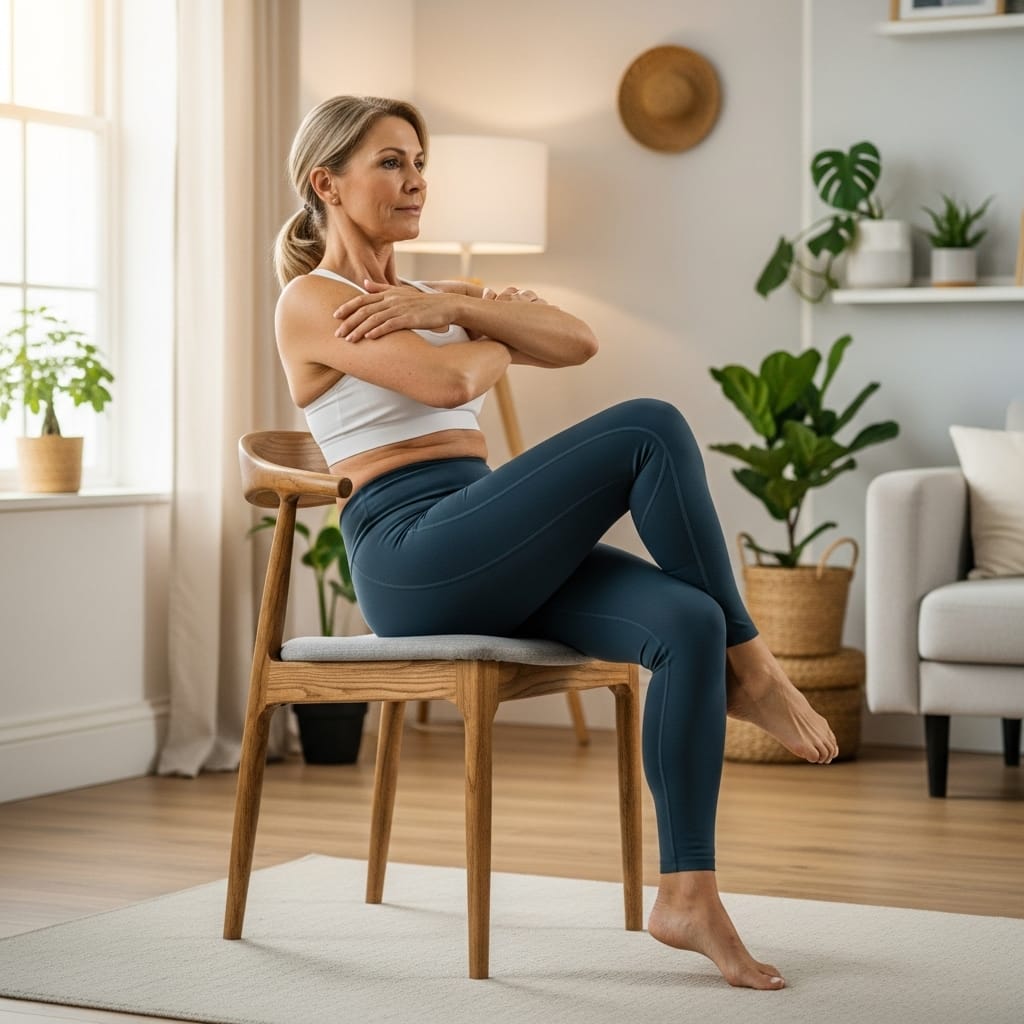
One of the biggest concerns for seniors is maintaining lower-body strength and hip mobility. Warrior I is a classic yoga pose traditionally performed standing, but the seated version is incredibly effective for toning the legs and improving posture without the risk of balance issues.
- How to do it: Turn your body so you are sitting sideways on the chair, with your right leg hanging off the side and your left buttock supported by the seat. Extend your right leg back behind you as far as is comfortable, keeping the toes tucked or the foot flat. Keep your left knee bent at a 90-degree angle. Square your chest forward and lift your arms toward the ceiling. Hold for five deep breaths, then switch sides.
- The Benefit: This pose targets the psoas and hip flexors—the muscles that get the shortest and tightest when we sit too much. By opening the front of the hip, you are relieving pressure on your lower back. Moreover, reaching your arms overhead builds shoulder mobility and encourages a taller, more confident posture. It makes you feel strong and capable, providing a psychological boost that counters the feeling of being “too tired.”
Pose 3: The Seated Forward Bend (The Calm Inducer)
After building a bit of heat and strength, the Seated Forward Bend is the perfect way to finish. This is a purely restorative move designed to quiet the mind and release the entire back of the body.
- How to do it: Sit tall with your feet wider than your hips. Take a deep breath in, and as you exhale, slowly hinge at your hips and lean forward. Let your hands slide down your legs toward your ankles, or if you feel flexible enough, let your fingertips touch the floor. Let your head hang heavy, releasing any tension in the back of your neck. Hold this for 30 to 60 seconds, breathing into your back ribs.
- The Benefit: This pose is a literal “reset” for your nervous system. By bringing your head below your heart, you are encouraging blood flow to the brain. This inversion has a profound calming effect, reducing anxiety and preparing your body for a better night’s sleep. It also provides a deep stretch to the lower back and the hamstrings, which are common areas of chronic pain for seniors.
Expanding Your Practice: The Power of Breath
While the physical poses are important, the “secret sauce” of chair yoga is the breath. In yoga, we call this Pranayama. When we are tired or stressed, our breathing becomes shallow and restricted to the upper chest. This type of breathing actually reinforces the feeling of fatigue by keeping the body in a low-level “emergency” state.
The “Sip” Breath for Energy
If you feel like you need a caffeine-free pick-me-up, try the “Sip Breath” while in your chair. Sit tall and take three short “sips” of air through your nose until your lungs are full. Hold for a second, then exhale slowly through pursed lips, like you are blowing through a straw. Repeat this five times. This technique rapidly increases the oxygen saturation in your blood, providing an immediate “jolt” of natural energy to your system.
Long Exhales for Calm
Conversely, if your fatigue is the “wired but tired” kind—where you feel exhausted but your mind is racing—focus on lengthening your exhales. Try to make your exhale twice as long as your inhale. This simple change stimulates the vagus nerve, which is the body’s primary “on-off” switch for the stress response. By mastering your breath, you are taking direct control over your internal state, regardless of how your day is going.
Making Chair Yoga a Sustainable Habit
The key to longevity and fitness after 60 isn’t intensity; it is consistency. You do not need to do an hour of yoga to see results. In fact, doing these three poses for just five minutes a day is far more effective than doing a 60-minute class once a month.
- Anchor the Habit: Try doing your chair yoga at the same time every day. A great time is right after you finish your morning coffee or while you are waiting for the news to start in the evening. By “stacking” the habit onto something you already do, you make it much easier to remember.
- Listen to Your Body: Some days you will have the energy to hold the Warrior I for a full minute; other days, you might just want to do a few gentle Cat-Cows. Both are perfectly acceptable. The goal is to move, not to achieve perfection.
- Stay Hydrated: Even gentle movement requires water. Ensure you drink a full glass of water after your session to help your body flush out the toxins released during the stretches.
Final Thoughts
The next time you feel “too tired to exercise,” remember that you don’t have to choose between total rest and a grueling workout. Chair yoga offers a middle path that honors your fatigue while simultaneously providing the solution to it. By incorporating these chair yoga poses into your daily routine, you are doing more than just stretching; you are investing in your bone density, your joint health, and your mental longevity. You are proving that your chair isn’t just a place to sit—it is a powerful tool for restoration. So, take a seat, take a breath, and discover how five minutes of movement can return the strength and calm you thought were gone for good.
Related Articles
- He’s 63, Ripped, and Defying Aging. What He Told Me About Muscles Blew My Mind—You Need to Hear This
- 10 Effortless Daily Habits That Keep Your Body Attractive Without Ever Stepping Into a Gym
- 15 Fitness Lies Men Over 50 Still Believe (And the Truth That Keeps You Strong)
- The #1 Exercise Strategy for Managing PCOS—And Why Most Women Do It Wrong
- Struggling With Balance? This 1 Daily Habit Could Keep You Steady for Life