FREE SHIPPING OVER $50

The ‘Minimum Effective Dose’: The 2-Day Workout Routine Researchers Say Matches Your 5-Day Grind

For years, the fitness industry has operated on a “more is better” philosophy that has left most of us feeling perpetually behind. We have been conditioned to believe that if we aren’t hitting the gym five, six, or even seven days a week, we might as well not go at all. This “all or nothing” mentality creates a massive psychological barrier for busy professionals, parents, and anyone juggling a modern schedule. We see the 5-day bodybuilder splits on social media and assume that is the entry price for a healthy body. Consequently, when life gets in the way, and we can only spare two days for exercise, we often give up entirely, feeling that a bi-weekly routine is a waste of time.
However, recent shifts in exercise science are proving that our obsession with frequency might be misplaced. Researchers are now highlighting a concept known as the “Minimum Effective Dose” (MED), which suggests that you can achieve nearly identical health and muscle-building results with a fraction of the time investment. A landmark study involving thousands of “Weekend Warriors”—people who cram their weekly exercise into just two sessions—found that their risk of cardiovascular disease and cancer was remarkably similar to those who worked out more frequently. This is a total game-changer for anyone who has ever felt “gym-shamed” for their busy schedule. It turns out that your body cares much more about the total work you do rather than how many times you swipe your gym card.
Why the “Weekend Warrior” Study Changed Everything
For a long time, the “Weekend Warrior” was the punchline of the fitness world. Conventional wisdom suggested that irregular exercise was a recipe for injury and stalled progress. However, a massive study published in JAMA Internal Medicine analyzed data from over 63,000 adults and delivered a shocking conclusion. The researchers found that as long as people met the recommended 150 minutes of moderate activity or 75 minutes of vigorous activity per week, it didn’t really matter if it was spread over seven days or packed into two.
Furthermore, the mortality risk for the two-day-a-week group was 30% lower than for sedentary individuals—nearly identical to the 35% lower risk seen in those who exercised more often. This proves that the “frequency” of your workouts is a secondary variable. The primary variable is the total volume and intensity. If you can move your body with enough intent during your two sessions, your heart, lungs, and metabolic system will reap the rewards just as if you were a daily gym rat.
The Science of Muscle Retention and Growth
A common fear with the 2-day routine is that you will lose muscle or fail to build any in the first place. Fortunately, the science of muscle protein synthesis (MPS) tells a different story. When you perform a resistance training session, your MPS levels remain elevated for roughly 36 to 48 hours. If you train your entire body on a Monday, your muscles are in a state of “growth and repair” until Wednesday.
While training five days a week allows you to hit different muscle groups more often, it also places a much higher demand on your central nervous system (CNS). By training just twice a week, you give your CNS and your joints ample time to fully recover. This means that when you do show up to the gym, you can perform with significantly higher intensity. Transitioning from “exhausted daily workouts” to “high-intensity bi-weekly workouts” often leads to a surprising increase in strength because the body is finally given the recovery time it has been craving.
The 2-Day Full Body Blueprint
To make a 2-day routine match a 5-day grind, you cannot use a traditional “body part split” where you only train your chest one day and your back the next. If you only have two days, every session must be a full-body routine. This ensures that every major muscle group is stimulated twice a week, which is the gold standard for maintaining and building lean mass.
To maximize these sessions, you should prioritize compound movements that recruit the most muscle fibers simultaneously. These “big rocks” of fitness include:
- Lower Body Push: Squats, lunges, or leg presses.
- Lower Body Pull: Deadlifts, Romanian deadlifts, or kettlebell swings.
- Upper Body Push: Bench press, overhead press, or push-ups.
- Upper Body Pull: Pull-ups, lat pulldowns, or rows.
- Core Stability: Planks, carries, or leg raises.
Day 1: The Foundation
This session focuses on heavy structural lifts that build a solid base of strength.
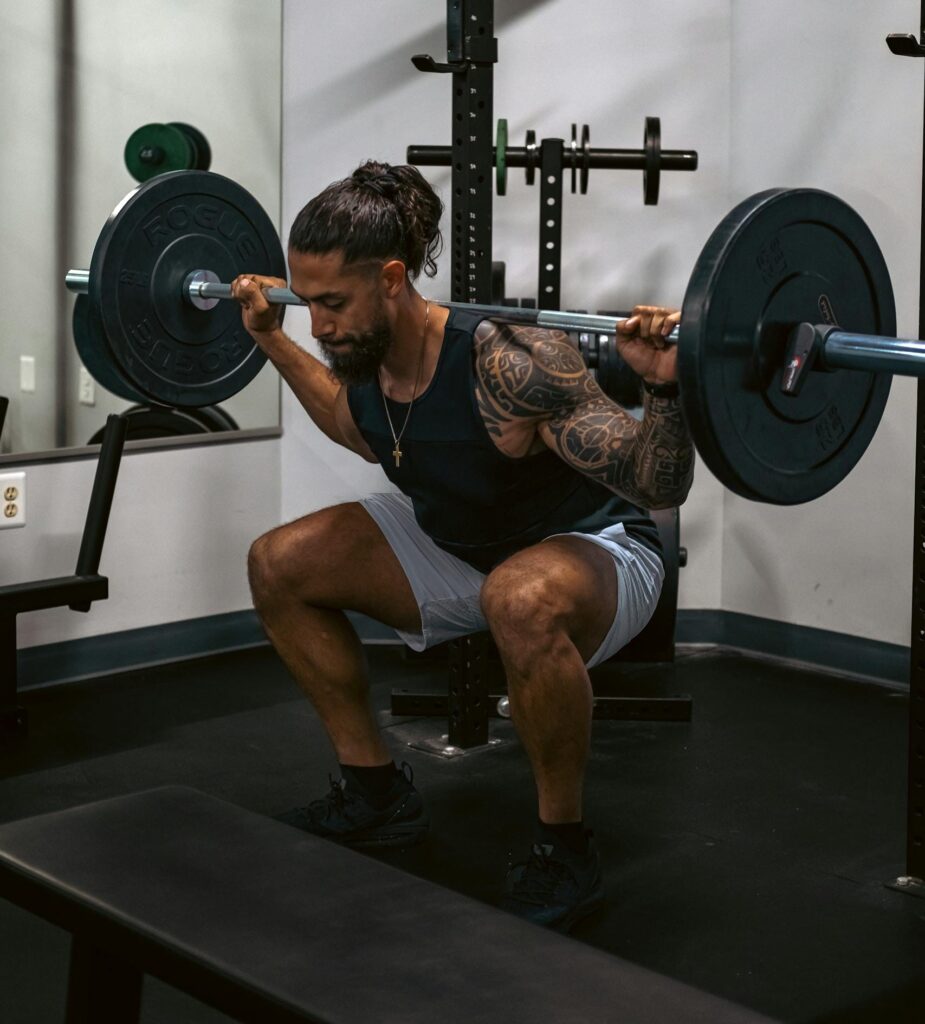
- Barbell Back Squats (or Goblet Squats): 3 sets of 6–8 reps.
- Bench Press (Dumbbell or Barbell): 3 sets of 8–10 reps.
- Barbell or Seated Cable Rows: 3 sets of 10–12 reps.
- Romanian Deadlifts: 3 sets of 8–10 reps.
- Plank with Alternating Leg Lifts: 3 sets to “near failure.”
Day 2: The Power & Stability
This session shifts the focus slightly to pull-dominant movements and overhead stability.
- Deadlifts (Conventional or Trap Bar): 3 sets of 5 reps (keep these heavy!).
- Overhead Press (Dumbbell or Barbell): 3 sets of 8–10 reps.
- Pull-Ups or Lat Pulldowns: 3 sets of 10–12 reps.
- Walking Lunges: 3 sets of 10 reps per leg.
- Hanging Leg Raises or Knee Tucks: 3 sets of 12–15 reps.
Exercise Substitutions: Build Your Own Path
Don’t have access to a barbell? Or perhaps a certain move hurts your joints? Use this substitution table to swap out any exercise while keeping the “Minimum Effective Dose” intact.
| Movement Category | Primary Exercise | Alternative 1 (Dumbbell) | Alternative 2 (Bodyweight/Home) |
| Lower Body Push | Barbell Squat | DB Goblet Squat | Bulgarian Split Squats |
| Lower Body Pull | Deadlift | DB Romanian Deadlift | Glute Bridges or Sliders |
| Upper Body Push | Bench Press | DB Chest Press | Push-Ups (Weighted if needed) |
| Upper Body Pull | Pull-Up | One-Arm DB Row | Inverted Bodyweight Rows |
| Shoulder Push | Barbell Overhead Press | DB Seated Press | Pike Push-Ups |
Intensity: The Secret Sauce of MED
If you are only working out twice a week, the one thing you cannot afford to do is “phone it in.” In a 5-day routine, you can get away with a few mediocre sessions. In a 2-day routine, intensity is non-negotiable. This doesn’t mean you need to vomit in a bucket, but it does mean you need to push your sets close to “mechanical failure.”
Research shows that the closer you get to the point where you can no longer perform a rep with good form, the more motor units your brain recruits. This intense recruitment is the signal that tells your body to get stronger and more resilient. Consequently, if you are doing two sets of 10 squats, those last two reps of each set should be genuinely challenging. By keeping the intensity high, you are compensating for the lower frequency and ensuring that your body has a “reason” to maintain its muscle mass and metabolic rate throughout the five days you aren’t at the gym.
Managing the “In-Between” Days
To truly make this “Minimum Effective Dose” routine feel like a 5-day grind, you should view the five days off as “active recovery” rather than “doing nothing.” This is where you can stack small, healthy habits that don’t require a gym.
- Daily Walking: Aim for a 20-minute walk every day. This keeps your joints lubricated and your insulin sensitivity high without adding any systemic fatigue.
- Mobility Work: Spend five minutes in the evening stretching your hips and shoulders to counteract the “office chair” posture.
- Protein Intake: Keep your protein intake high even on non-training days. This provides the “bricks” your body needs to rebuild the “wall” you knocked down during your two intense sessions.
Final Thoughts
The “Minimum Effective Dose” isn’t about being lazy; it is about being a strategist with your own health. The science is increasingly clear: you do not need to live in the gym to look, feel, and perform like an athlete. By focusing on two high-intensity, full-body sessions per week, you are meeting the biological requirements for a long, healthy life and a strong physique. This approach matches the 5-day grind by prioritizing compound movements, recovery, and total weekly volume over mindless frequency.
Related Articles
- Surgeon Reveals: The 5-Minute “Posture Hack” That Instantly Slims Your Waist and Boosts Metabolism After 40
- 1 Daily Stretch That Fixed My Forward Head Posture—and Even Changed My Face
- Over 45? These 4 Wall Exercises Rebuild Strength and Fight Muscle Loss Better Than Shakes
- Stop Wasting Time: The 3 Old Man Exercises That Build Muscle Faster Than Any Modern Machine
- The Hidden Muscle-Building Zone Most People Ignore—And Why It Matters More Than Your Workout