FREE SHIPPING OVER $50

The “Bulletproof” Shoulder Secret: The 1 Move I Give Every Athlete for Instant Mobility

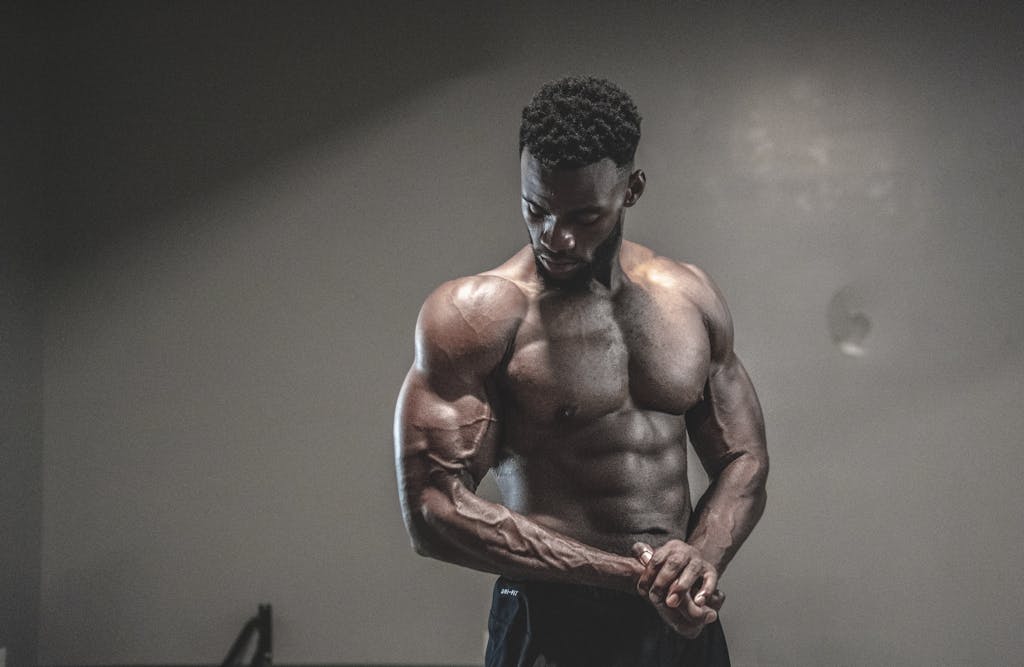
If you have spent any significant time in a weight room, you probably know the “shoulder prayer.” It is that specific ritual where you stand in front of the dumbbell rack, gingerly rotating your arms in small circles, hoping your rotator cuff doesn’t “click” or “pinch” during your first set of overhead presses. Most lifters and athletes accept shoulder stiffness as an inevitable tax for being active. We spend hundreds of dollars on massage guns, specialized bands, and elaborate warm-up routines that take longer than the actual workout. Yet, despite all this effort, the moment we go heavy or try to reach behind the back seat of the car, that familiar, sharp ache returns. It is incredibly frustrating to feel like your own joints are the primary bottleneck to your progress.
After coaching weightlifting and mobility for over a decade, I have realized that the solution to most shoulder problems isn’t a complex ten-step program. Instead, it is a single, foundational movement that we have largely forgotten as we transitioned into adulthood. I call it the “Bulletproof Secret,” and it is the first thing I teach every athlete who walks into my gym with “rusty” joints. This move doesn’t require expensive equipment or a PhD in kinesiology; it simply requires a pull-up bar and the willingness to let gravity do the heavy lifting.
The Modern Shoulder Trap
The human shoulder is the most mobile joint in the entire body. It is a “ball and socket” joint designed for an incredible range of motion, allowing us to throw, climb, and push in almost any direction. However, modern life has turned this engineering marvel into a liability. Most of us spend between eight to twelve hours a day in what I call the “Internal Rotation Trap.” Whether we are typing on a laptop, driving a car, or scrolling through our phones, our shoulders are hunched forward, and our chests are tight.
Consequently, the space between the top of your arm bone (the humerus) and the bone that sits above it (the acromion) becomes dangerously narrow. This is known as the subacromial space. When this space shrinks, it begins to “pinch” the rotator cuff tendons and the bursa sac. This is why you feel that sharp pain when you lift your arm out to the side. Traditional stretching often fails to fix this because it only pulls on the muscles; it doesn’t address the mechanical narrowing of the joint itself. To truly “bulletproof” the shoulder, you need a move that creates space and resets the joint’s alignment.
The Secret Move: The Dead Hang
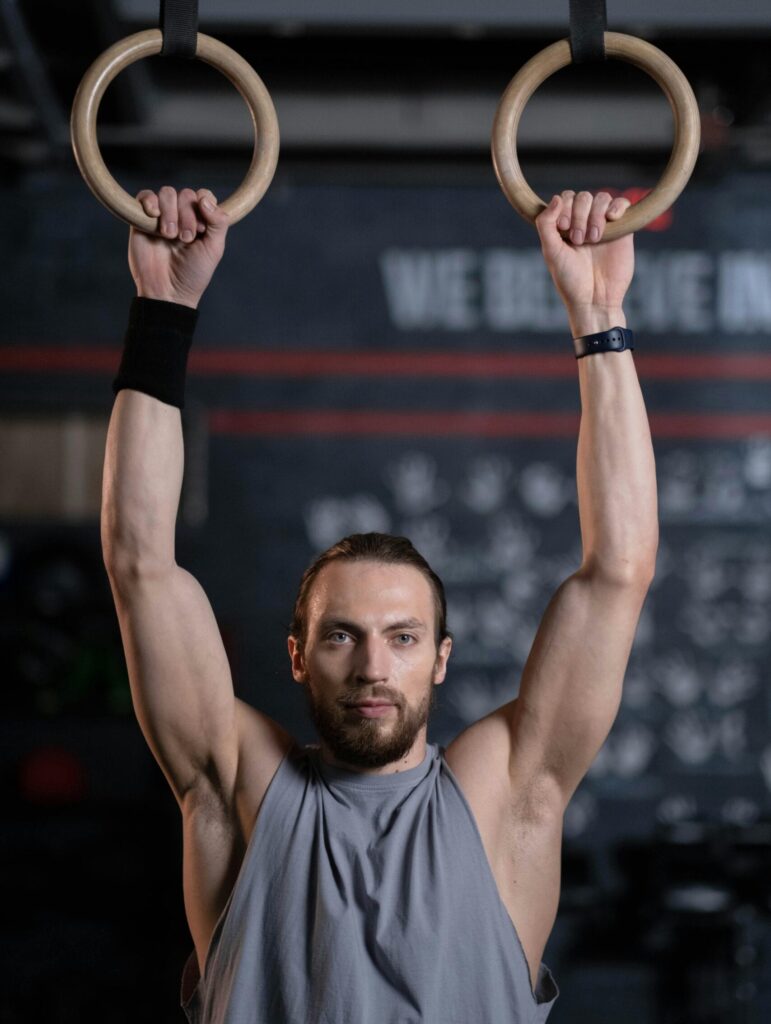
The Dead Hang is exactly what it sounds like: grabbing a pull-up bar and hanging with your full body weight. While it looks simple, the biological effects are profound. This movement utilizes the principle of traction. When you hang, gravity pulls your humerus away from the acromion, instantly widening that subacromial space. This decompression allows the rotator cuff tendons to “breathe” and receive blood flow that is usually cut off by constant impingement.
Furthermore, hanging engages a biological process called remodeling. Orthopedic surgeons have documented how consistent hanging can actually reshape the coracoacromial ligament. Over time, the mechanical stress of hanging can slightly bend the acromion bone upward, permanently increasing the space in your shoulder joint. This is the difference between a temporary “feel-good” stretch and a permanent structural change.
Shoulder Health Comparison: Stretching vs. Hanging
| Feature | Traditional Static Stretching | The Dead Hang (Traction) |
| Primary Target | Muscle Fibers | Joint Space & Ligaments |
| Mechanical Effect | Lengthens muscle tissue | Decompresses subacromial space |
| Nervous System | Often triggers “stretch reflex” | Promotes relaxation and safety |
| Structural Change | Temporary length increase | Can reshape the acromion bone |
| Grip Integration | None | Massive grip and forearm stimulus |
Two Ways to Hang: Passive vs. Active
To get the most out of this secret move, you need to understand the two different “modes” of the Dead Hang. Most people start with the Passive Hang. In this version, you simply relax into the move. You let your shoulders touch your ears and allow your spine to decompress. This is the “mobility” phase. It is perfect for opening up the thoracic spine and stretching the lats, which are often the hidden culprits behind shoulder stiffness.
However, to truly “bulletproof” the joint, you must transition into the Active Hang. In the active version, you pull your shoulder blades down and back—away from your ears—while keeping your arms straight. This engages the lower trapezius and the serratus anterior, the muscles responsible for stabilizing the shoulder blade. By alternating between these two modes, you are teaching your shoulder how to be both supple and incredibly strong.
The Bulletproof Protocol
I recommend that my athletes follow a progressive volume approach. You do not want to jump into a three-minute hang on day one if you haven’t touched a pull-up bar in years. Start by accumulating time rather than trying to hit a single long set.
- Week 1: Accumulate 2 minutes of total hanging time per day. Break this into 20-second “mini-sets.” Focus on Passive Hanging to open the joint.
- Week 2: Accumulate 3 minutes of total hanging time. Introduce 10 seconds of “Active” tension at the end of every 30-second hang.
- Week 3: Accumulate 4 minutes. Focus on “Scapular Shrugs”—moving between the Passive and Active positions without letting go of the bar.
- Week 4: Aim for a single 60-second unbroken hang. At this stage, your grip strength and shoulder stability will have significantly surpassed your peers.
The “Instant” Mobility Effect
One of the reasons I give this move to every athlete is the immediate feedback. If you test your “overhead reach” before a 30-second hang and then test it again immediately after, the difference is often shocking. This is because hanging “resets” the scapulohumeral rhythm. This is the coordinated movement between your shoulder blade and your arm bone. When your lats and pecs are tight, they “glue” the shoulder blade down, forcing the arm bone to do all the work, which leads to impingement.
Hanging acts like a “reset button” for this coordination. It stretches the fascia and muscles that are pinning the shoulder blade down, allowing it to glide freely along the rib cage again. This is why athletes who incorporate a single minute of hanging before their bench press or snatch sessions often find they can hit deeper ranges of motion with zero pain. You are essentially “oiling” the joint through mechanical tension.
Why Grip Strength Matters for Shoulders
A hidden benefit of the Dead Hang is the massive increase in grip strength. There is a fascinating neurological connection called irradiation. When you grip something extremely hard, your nervous system automatically “turns on” the muscles in your rotator cuff and your core to provide stability.
If you have a weak grip, your brain perceives your shoulder as being “unstable” and will often send pain signals or “tighten” the muscles to prevent you from getting injured. By building a crushing grip through hanging, you are signaling to your nervous system that the shoulder is safe and capable of handling heavy loads. Consequently, many people find that their “shoulder pain” disappears simply because their grip becomes strong enough to stabilize the entire upper extremity.
Final Thoughts
Building bulletproof shoulders doesn’t require a suitcase full of specialized equipment or a complex routine. It requires a return to the basic human movement of hanging. By utilizing the Dead Hang, you can provide instant mobility to your joints, decompress the subacromial space, and build the grip strength necessary for elite performance. This one move addresses the structural, mechanical, and neurological aspects of shoulder health simultaneously. Stop overcomplicating your mobility and start letting gravity do the work.
Related Articles
- Forget Melatonin: New Study Shows These 3 Workouts Beat Sleeping Pills (And #2 Is a Total Shock)
- 10 Effortless Daily Habits That Keep Your Body Attractive Without Ever Stepping Into a Gym
- 15 Fitness Lies Men Over 50 Still Believe (And the Truth That Keeps You Strong)
- Push-Ups Are Overrated—These 3 Shoulder Moves Build More Strength, Says a Weightlifting Coach
- The #1 Exercise Strategy for Managing PCOS—And Why Most Women Do It Wrong