FREE SHIPPING OVER $50

The Balance Drill Physical Therapists Prescribe After 60 That Cuts Fall Risk More Effectively Than Most Strength Workouts

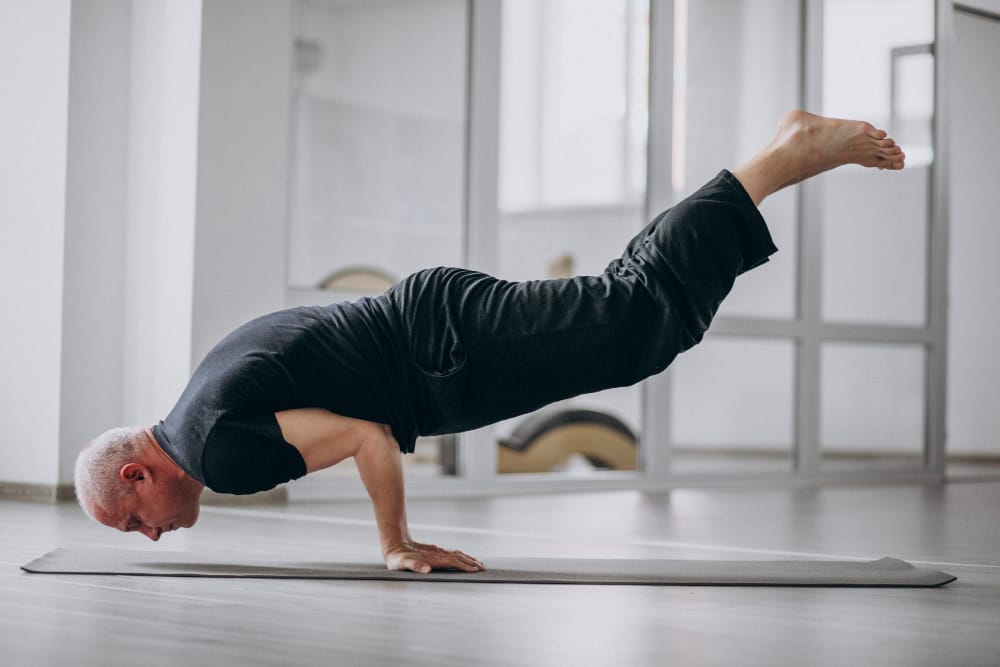
If you are over 60 and spending all your gym time on the leg press machine to prevent falls, you might be missing the most critical component of human stability. While muscle strength is undeniably important, falling is rarely a failure of raw power; rather, it is a failure of communication between your brain, your inner ear, and your ankles. Physical therapists have long known that “functional “balance” relies on a rapid-fire neurological loop called proprioception, which often degrades faster than our muscle mass as we age. To combat this, experts are moving away from traditional squats and toward a specific balance drill. This exercise doesn’t just build muscle; it re-wires your internal GPS, allowing you to catch a stumble before it turns into a disaster.
Why Strength Training Isn’t Enough for Balance
Many people believe that stronger legs automatically equal better balance. However, clinical research suggests that the correlation is weaker than we once thought. You can have the strongest quadriceps in the world, but if your brain doesn’t receive the signal that your center of gravity has shifted until it is too late, those muscles won’t fire in time to save you.
Balance is a complex “triple-threat” system. Your brain relies on three distinct inputs to keep you upright:
- The Visual System: What your eyes see in relation to the horizon.
- The Vestibular System: The “liquid levels” in your inner ear that detect head movement.
- The Somatosensory System: The tiny sensors in your feet and joints (proprioceptors) that tell you where your limbs are in space.
As we age, we tend to become “visually dominant,” meaning we rely too much on our eyes. If the lighting is dim or we look away, our balance crumbles. The specific drill prescribed by therapists forces the brain to stop “cheating” with the eyes and start trusting the feet and ears again.
The Anatomy of a Fall: The “Reactive” Gap
A fall usually happens in a split second—the moment between a trip and the ground. This is known as the “Reactive Gap.” Strength workouts usually focus on “proactive” movements where you control the tempo and the weight. In contrast, balance drills focus on “reactive” stability.
Physical therapists prioritize drills that challenge the nervous system’s ability to correct a mistake. If you only train on stable machines, your nervous system becomes “lazy.” By introducing “controlled instability,” you train the fast-twitch fibers in your ankles and hips to react with lightning speed. This “neuromuscular efficiency” is what actually prevents the hip fractures and injuries that change lives after 60.
Proactive Strength vs. Reactive Balance
| Feature | Traditional Strength Training | Reactive Balance Drills |
| Primary Goal | Force Production (Push/Pull) | Force Correction (Stabilizing) |
| Brain Focus | Conscious Effort | Subconscious Reflex |
| Equipment | Weights, Machines | Floor, Foam, or Single Leg |
| Fall Prevention | Medium Impact | High Impact |
| Time Needed | 45-60 Minutes | 2-5 Minutes |
The “Three-Point Reset”: The Gold Standard Drill
The drill that therapists are currently swearing by is called the Three-Point Reset (sometimes referred to as the Star Excursion Lite). It is designed to challenge your “limit of stability” while keeping your core anchored.
How to Perform the Drill
Stand near a kitchen counter or a sturdy chair for safety. Stand on your right leg with a slight, athletic bend in the knee. Visualize a clock face on the floor.
- Point 1: With your left foot, reach forward to “12 o’clock” and lightly tap the floor with your toe without putting weight on it. Return to the center.
- Point 2: Reach your left foot out to the side to “9 o’clock” and tap. Return to the center.
- Point 3: Reach your left foot behind you to “6 o’clock” and tap. Return to the center.
The goal isn’t to reach as far as possible; it is to keep your standing knee perfectly stable and your hips level while you reach. Perform 5 rounds per leg.
Why it Works
This drill forces your standing ankle to make hundreds of tiny “micro-adjustments” every second. This strengthens the “lateral stabilizers” of the hip—specifically the gluteus medius—which is the muscle responsible for keeping you from swaying side-to-side when you walk.
The “Closed-Eye” Progression
Once you master the Three-Point Reset with your eyes open, therapists often suggest the most difficult version: performing a simple single-leg stand with your eyes closed. By removing the visual input, you force the brain to rely 100% on the inner ear and the sensors in the soles of your feet.
This is where the real “re-wiring” happens. When you close your eyes, you will likely feel a “wobble” in your ankle. That wobble is your nervous system practicing. Each time you “catch” yourself from tipping, you are building a stronger neural pathway. This is “Physical Insurance.” The more you practice these small catches in a safe environment, the better your brain will handle a real-life trip on a sidewalk or a rug.
Integrating Balance into Your Daily Rituals
The beauty of the Three-Point Reset and other balance drills is that they don’t require a gym membership or a change of clothes. In fact, they are most effective when done frequently in short bursts. Consistency is the primary driver of neurological change.
- The Coffee Habit: Practice your single-leg “12-9-6” taps while your morning coffee is brewing.
- The Toothbrush Challenge: Stand on one leg while brushing your teeth (switch legs halfway through).
- The Commercial Break: During your favorite show, stand up and perform 3 rounds of the Three-Point Reset on each leg.
By weaving these into your existing routine, you ensure that your “Stability System” is being calibrated multiple times a day. Over 30 days, this frequent “pinging” of the nervous system leads to a significant decrease in postural sway and an increase in walking speed.
The Role of Foot Health in Stability
You cannot have good balance if your feet are “numb” to the ground. Many seniors wear highly cushioned, thick-soled shoes that act like earplugs for the feet. They dampen the sensory feedback the brain needs to stay upright.
Physical therapists often recommend doing your balance drills barefoot or in very thin socks. This allows the thousands of nerve endings in the soles of your feet to feel the texture and angle of the floor. Strengthening the “intrinsic muscles” of the feet provides a wider, more stable base, much like the roots of a tree.
Related Articles
- Stop Overcomplicating Fitness: The Only 5 Workouts a Total Beginner Needs to See Results
- Nobody Tells You That the Push-Ups You’ve Been Doing Your Whole Life Barely Touches Your Chest — These 3 Variations Fix That
- Stop Wasting Hours: Scientists Say This 20-Minute Window Is the ONLY Time You Need to Build Muscle
- 5 Chair Exercises That Flatten Belly Fat Faster Than Crunches (Perfect for Women Over 50)
- 7 Glute Moves That Sculpt, Lift, and Strengthen—No Squats Required