FREE SHIPPING OVER $50
Flabby Arms?: The 4 “Anti-Gravity” Moves That Tighten Bat Wings Faster After 45

If you have ever caught a glimpse of your reflection while waving goodbye and noticed a bit more “jiggle” than you’d like, you are certainly not alone. For many of us, the area underneath the upper arms—often affectionately or frustratingly called “bat wings”—becomes a primary point of concern as we cross the mid-40s. It feels as though gravity has suddenly decided to work double-time on our triceps, turning once-firm limbs into something that feels a bit more like crepe paper. While the fitness industry often suggests that the only solution is to start hoisting heavy iron at a crowded gym, the reality is that high-impact weightlifting can often be tough on aging joints, leading to more aches than actual results.
The secret to reclaiming that sleeveless confidence doesn’t actually require a rack of dumbbells or an expensive gym membership. Instead, the most effective way to firm up this stubborn area is by utilizing “Anti-Gravity” bodyweight moves that leverage your own mass to create high levels of tension exactly where you need it. These movements are specifically designed to address the physiological changes that happen after 45, such as the natural decline in muscle mass and the loss of skin elasticity. By focusing on the way your muscles interact with gravity, you can tighten the tricep area faster and more safely than traditional lifting.
Why “Bat Wings” Happen: The Science of Aging Arms
Before we dive into the exercises, it is important to understand what we are actually fighting. The sagging we see in our upper arms after 45 is usually the result of a “perfect storm” of three biological factors. First is Sarcopenia, which is the age-related loss of skeletal muscle mass. Starting in our 30s, we begin to lose between 3% and 5% of our muscle mass per decade. By the time we hit 45, the triceps can become quite thin, leaving the skin with nothing to “hang” onto.
The second factor is the decline in Collagen and Elastin production. These proteins are the “glue” that keeps our skin snapped tight against our muscles. As these levels drop, the skin becomes less resilient. Finally, there is the issue of Subcutaneous Fat storage, which often shifts during hormonal changes (like perimenopause or andropause), preferring to settle in the upper arms. Consequently, to fix the problem, we need a solution that builds the muscle underneath while pulling the skin taut through metabolic stress.
The “Anti-Gravity” Advantage Over Traditional Weights
You might wonder why bodyweight moves are touted as “faster” than weightlifting for this specific demographic. The answer lies in Time Under Tension (TUT) and joint health. When you lift a 5-pound dumbbell, the resistance is constant and often limited by the strength of your wrists or elbows. However, when you use your body weight, you are forcing the triceps to stabilize your entire frame. This requires a much higher level of neurological “recruitment,” meaning you are firing more muscle fibers in a single movement.
Bodyweight vs. Traditional Weightlifting After 45
| Feature | Bodyweight “Anti-Gravity” Moves | Traditional Dumbbell Training |
| Joint Impact | Low; natural range of motion. | Moderate to High; can strain elbows. |
| Muscle Recruitment | High; involves core and stabilizers. | Isolated; usually only hits one muscle. |
| Equipment Needed | None; just your floor or a chair. | Dumbbells, racks, and benches. |
| Functional Strength | High; helps with daily pushing tasks. | Moderate; primarily aesthetic. |
| Accessibility | Can be done anywhere, anytime. | Requires a gym or home setup. |
Move 1: The Modified Diamond Press-Up
Standard push-ups are great for the chest, but if you want to target the “bat wing” zone specifically, you need to change your hand placement. The Diamond Press-Up is the gold standard for tricep activation because it places the maximum load directly onto the three heads of the triceps brachii.
To perform this move correctly, start on your knees to protect your lower back and maintain form. Place your hands close together on the floor so that your index fingers and thumbs form a diamond shape. As you lower your chest toward your hands, keep your elbows tucked tightly against your ribs. Do not let them “flare” out to the sides. This “tucked” position is what creates the anti-gravity tension. Push back up forcefully, feeling the back of your arms do 100% of the work. Aim for 3 sets of 10 to 12 repetitions.
Move 2: The Elevated Chair Dip
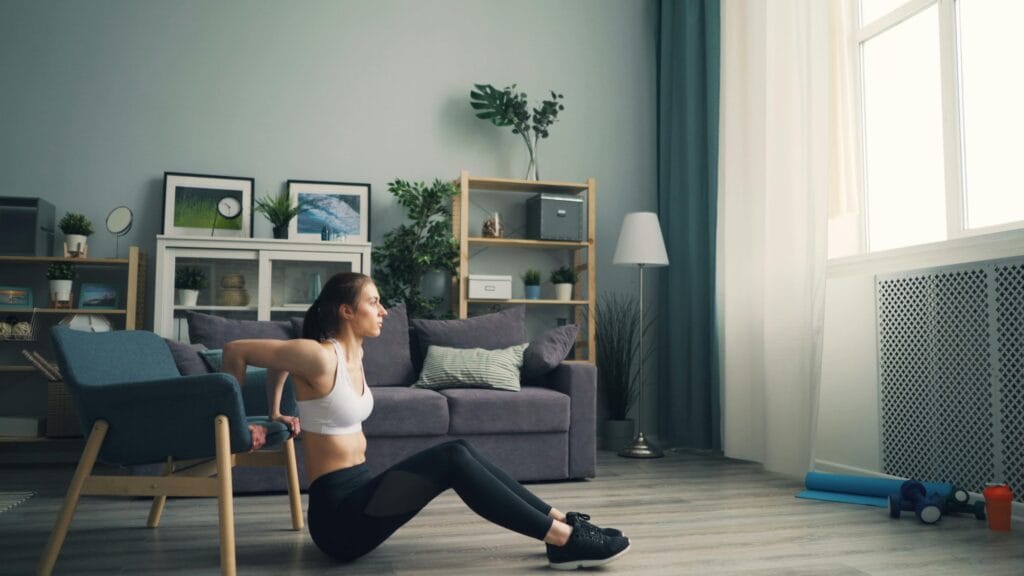
This move is a classic for a reason—it works. However, after 45, we have to be mindful of shoulder impingement. Instead of using deep parallel bars at a gym, using a sturdy kitchen chair or the edge of your sofa allows for a more controlled, “joint-friendly” range of motion.
Sit on the edge of the chair and place your hands next to your hips. Slide your bottom off the seat while supporting your weight with your arms. Keep your knees bent at a 90-degree angle to start; this allows your legs to assist if the move becomes too difficult. Lower your hips toward the floor by bending your elbows until they reach a 90-degree angle, then press back up. The key is to keep your back as close to the chair as possible. If you walk your feet out too far, you shift the load to your shoulders, which we want to avoid. This move “pulls” the muscle upward against gravity, creating that sought-after tightening effect.
Move 3: The Plank-to-Down Dog Flow (Tricep Press)
This is a dynamic move that combines the core stability of a plank with the targeted tricep extension of a press. It is highly effective because it changes the angle of gravity on your arms as you move, hitting the muscle fibers that traditional lifting often misses.
- Start in a High Plank: Ensure your wrists are directly under your shoulders and your core is “zipped up” tight.
- The Shift: Instead of just pushing your hips back, focus on using your forearms to “press” the floor away from you as you move into a Downward Dog position.
- The Extension: Your triceps should be screaming as you transition between these two points.
- The Return: Slowly lower back into the plank, resisting gravity on the way down. This “eccentric” phase is where most of the muscle-tightening magic happens.
Move 4: The Tricep Pulse (The “Burnout”)
While the first three moves focus on strength, the Tricep Pulse focuses on metabolic stress. This move doesn’t look like much, but after 30 seconds, you will understand why it’s a favorite in Pilates and Barre circles. It is perfect for finishing off the muscle and encouraging blood flow to the skin tissues.
Stand with your feet hip-width apart and lean your torso forward slightly, keeping a flat back. Reach your arms straight back behind you, palms facing the ceiling, so they are higher than your hips. Now, perform tiny, one-inch pulses upward toward the ceiling. Keep your arms as straight and “long” as possible—think about reaching for the wall behind you. This constant tension prevents the muscle from resting, forcing it to tighten and firm up. Perform this for 60 seconds straight to finish your routine.
Conclusion
Taming flabby arms after 45 doesn’t require a radical lifestyle shift or hours spent in a weight room. By understanding the Exercise Science behind Sarcopenia and using these four Anti-Gravity moves, you can effectively bypass the limitations of traditional lifting. Consistency is key; performing this routine just three times a week can lead to visible changes in skin tightness and muscle definition in as little as 21 days. Remember, your body is your best piece of gym equipment—use it to defy gravity and wave goodbye to bat wings for good.
Related Articles
- 92% of New Year Workouts Fail by February: The ‘Identity Shift’ Secret to Beating the Odds
- The 5 Secret Exercises A-List Celebrities Swear By to Stay Muscular at Any Age
- Stop Wasting Hours: Scientists Say This 20-Minute Window Is the ONLY Time You Need to Build Muscle
- 5 Chair Exercises That Flatten Belly Fat Faster Than Crunches (Perfect for Women Over 50)
- 7 Glute Moves That Sculpt, Lift, and Strengthen—No Squats Required