FREE SHIPPING OVER $50
Scientists Just Found the Cure for Balding Hiding Inside Your Own Body—Here’s How They’re Unlocking It

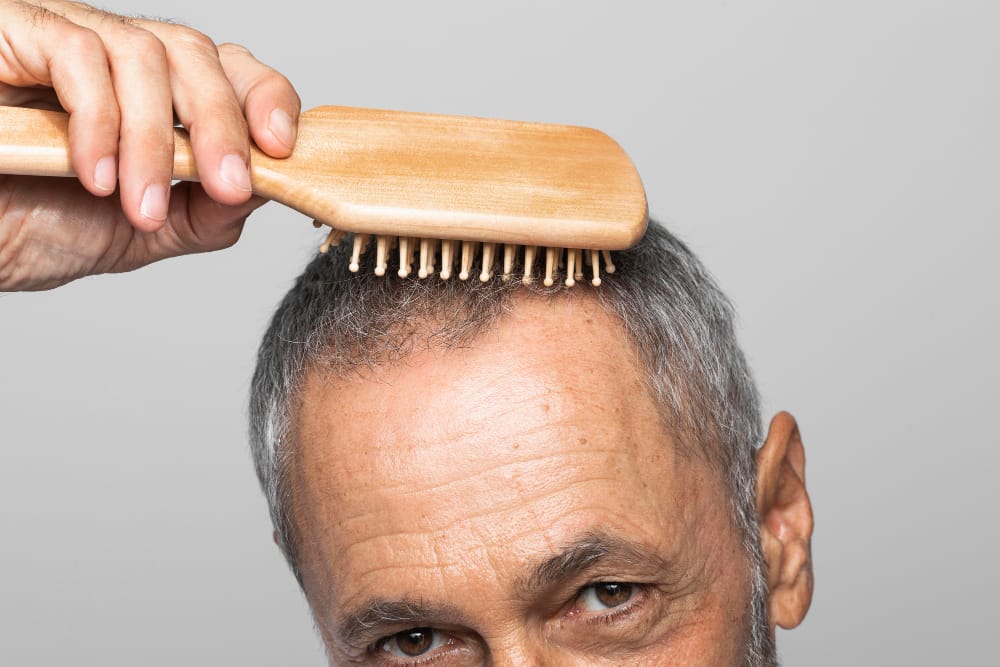
For decades, fighting hair loss meant choosing between greasy topical foams, daily pills with unwanted side effects, or expensive surgical transplants that simply relocate hair from the back of your head to the front. However, groundbreaking advances in regenerative medicine reveal that the ultimate key to reversing male and female pattern baldness is not found in a synthetic pharmaceutical lab, but sitting dormant inside your own skin cells. Researchers have unlocked specific biological signaling molecules—such as a newly discovered protein called SCUBE3—that act as a master key, commanding sleeping hair follicles to wake up and produce thick, youthful hair once again.
The Hidden Truth: Your Hair Follicles Do Not Die
To understand how this internal biological cure works, you first need to dispel a common myth about balding. Most people assume that when hair thins and recedes, the underlying hair follicles wither away and die completely.
In reality, your hair follicles remain alive beneath the surface of your scalp throughout your entire life. What actually happens during androgenetic alopecia—commonly known as pattern baldness—is a breakdown in cellular communication.
Inside every hair follicle sits a specialized cluster of cells known as the dermal papilla. These dermal papilla cells act as the command center for hair growth. They send chemical messages to neighboring stem cells, telling them when to divide, grow new strands, or take a temporary rest.
As you age, sensitivity to dihydrotestosterone (DHT) and localized inflammation cause these dermal papilla cells to fall silent. As a result, the follicle shrinks, produces progressively finer hairs, and eventually enters a state of permanent dormancy. The physical machinery to grow hair remains intact, but the start button is never pressed.
“Hair follicles do not vanish when you go bald; they simply lose their chemical instructions to grow. Re-establishing those cellular signals is the key to true hair regeneration.”
The Biological Breakthrough: How SCUBE3 Triggers Hair Regrowth
A major breakthrough occurred when researchers at the University of California, Irvine investigated how dermal papilla cells communicate when they are hyperactive. The research team studied a specific mouse model with hyper-abundant hair growth and discovered that these active cells produce a previously unknown signaling molecule called SCUBE3.
SCUBE3 functions as a powerful messenger protein. When dermal papilla cells release SCUBE3, it travels to adjacent hair stem cells and delivers an unmistakable instruction: exit the resting phase and start manufacturing a new hair shaft immediately.
When researchers applied micro-amounts of SCUBE3 to human hair follicles transplanted onto lab models, the results were astonishing. The dormant human follicles woke up, re-entered the active growth phase (known as the anagen phase), and began producing robust, healthy hair.
Another complementary compound discovered by researchers is osteopontin, a protein that works alongside SCUBE3 to stimulate aging follicle stem cells. Together, these naturally occurring molecules prove that your body already possesses the genetic blueprint to grow full hair at any age.
How Scientists Are Unlocking Your Body’s Internal Regrowth System
Now that scientists have identified the exact chemical signals responsible for hair growth, biotechnology companies are developing precise therapies to deliver these signals directly to sleeping follicles.
Instead of forcing your body to tolerate synthetic chemicals, these next-generation treatments harness your native biology to restore natural hair cycles.
1. Dermal Papilla Cell Banking and Cloning
One of the most promising clinical approaches involves harvesting a small sample of your healthy, hair-bearing skin from the back of your scalp. Scientists isolate your personal dermal papilla cells and multiply them by the millions inside a specialized lab environment.
Once cloned, clinicians reinject these refreshed, highly active cells directly into thinning areas of your scalp. These fresh cells instantly begin releasing SCUBE3 and other growth factors, effectively reprogramming surrounding dormant follicles to behave like young, healthy tissue.
2. Exosome Therapy and Messenger RNA
Exosomes are tiny extracellular vesicles that act as the postal system of your cellular world. They carry proteins, lipids, and messenger RNA (mRNA) from healthy stem cells directly to damaged or aging tissues.
Advanced hair restoration clinics are utilizing specialized exosome formulations packed with hair-growth signals. When micro-injected into the scalp, these exosomes fuse with dormant follicle cells, delivering the exact genetic instructions required to restart protein synthesis and blood vessel formation.
3. Autologous PRF (Platelet-Rich Fibrin)
While basic Platelet-Rich Plasma (PRP) has been used for years, next-generation Platelet-Rich Fibrin (PRF) takes autologous therapy further. By spinning your blood at lower speeds without synthetic anticoagulants, doctors create a natural fibrin matrix rich in platelets, white blood cells, and progenitor stem cells.
When injected into your scalp, this fibrin matrix slowly releases localized growth factors over a period of two weeks, supplying sleeping follicles with continuous nutrients and biological signaling.
Traditional Treatments vs. Next-Gen Biological Hair Regeneration
To see why cellular signaling represents such a massive leap forward for longevity and aesthetics, review how modern biological approaches compare to traditional treatments.
| Feature / Metric | Traditional Minoxidil | Oral DHT Blockers | Next-Gen Cellular Signaling (SCUBE3/Stem Cells) |
| Primary Mechanism | Increases local blood flow | Blocks systemic hormone conversion | Delivers direct biological signals to stem cells |
| Source of Active Agent | Synthetic chemical compound | Synthetic chemical compound | Bio-identical molecules / Autologous cells |
| Targeting Precision | Low (treats surface symptoms) | Low (alters systemic hormones) | High (targets dermal papilla command center) |
| Permanence of Results | Hair falls out if stopped | Hair falls out if stopped | Potential long-term restoration of native cycles |
| Common Side Effects | Scalp redness, unwanted facial hair | Hormonal imbalances, fatigue | Minimal (uses natural human cellular signals) |
4 Ways to Support Your Follicle Signaling Right Now
While bio-identical SCUBE3 topical treatments complete clinical trials and regulatory approvals, you can adopt several practical strategies today to protect your dermal papilla cells and encourage natural signaling.
- Incorporate Weekly Scalp Microneedling: Using a micro-needling device (0.5mm to 1.0mm) creates controlled micro-injuries in the outer scalp layer. This physical stimulation triggers a localized natural wound-healing cascade, releasing endogenous growth factors like PDGF and VEGF.
- Utilize Low-Level Laser Therapy (LLLT): Medical-grade red light therapy at 650 nanometers penetrates the scalp to stimulate mitochondrial ATP production inside dermal papilla cells, giving them the cellular energy needed to maintain signaling.
- Practice Scalp Tension Release: High physical tension across the cranial fascia compresses small blood vessels, restricting oxygen and allowing DHT to accumulate. Daily manual scalp massages help relax the aponeurosis tissue and restore micro-circulation.
- Optimize Cellular Micronutrients: Ensure your diet contains ample zinc, marine collagen peptides, and bioavailable iron. These nutrients serve as essential co-factors for hair protein synthesis and stem cell division.
What This Cellular Shift Means for the Future of Longevity
The discovery of internal hair growth messengers like SCUBE3 marks a fundamental shift in how medicine views aging. For decades, hair loss was treated as an inevitable cosmetic failure that required masking or harsh chemical suppression.
Today, longevity researchers view hair follicle miniaturization as a reversible form of localized cellular senescence. By learning how to talk to our cells and reset their signaling pathways, we are discovering that many signs of aging are simply dormant programs waiting for the right instruction to reactivate.
Related Articles
- Forget Cardio—These 5 Longevity-Boosting Strength Exercises Are the Real Fountain of Youth After 50 (Add 10 Years, Feel 20)
- How One Woman Reversed 10 Years of Aging With These 2 Lifestyle Tweaks
- Revealed: The Supplement Helping People Over 40 Build Muscle Faster
- The Secret to Building Muscle Over 40—Without Lifting Heavy Weights
- Why Cristiano Ronaldo’s Deep Breathing Could Be Your Key to Anti-Aging and Calm