FREE SHIPPING OVER $50

I Quit Squats and Lunges for 30 Days and Did This One Pilates Move Instead — My Glutes, Core, and Lower Back Have Never Felt Better

After years of believing that heavy barbell squats and deep lunges were the only way to build a functional posterior, I found myself sidelined by persistent lower back tweaks and “achy” knees that made every leg day feel like a gamble. In a moment of frustration, I decided to bench the heavy weights for 30 days and replace my entire lower-body routine with one specific, targeted Pilates movement. While it sounds simple, this shift moved the mechanical load away from my overtaxed spine and directly into my dormant gluteal fibers, forcing a level of deep core stability that traditional standing exercises often bypass. By focusing on “Isolation over Volume,” I managed to achieve a visible lift in my glutes and a rock-solid core without the inflammatory “hangover” of high-impact training, proving that sometimes the most effective way to get stronger is to stop fighting your own anatomy.
The Problem with “Squat-Dominance” and Back Pain
For most fitness enthusiasts, the squat is the undisputed king of leg exercises. However, for a significant portion of the population—especially those with desk jobs—the squat can be a “noisy” movement. When your hip flexors are tight and your core is slightly weak, your body compensates by arching the lower back to move the weight. This shifts the tension away from your glutes and onto your lumbar spine, leading to that familiar “compressed” feeling after a workout.
Lunges often present a similar issue. If your “Mind-Muscle Connection” isn’t perfect, your quads and knees end up doing 90% of the work. By switching to a supine (lying on your back) Pilates-based movement, you remove the vertical compression on your spine. This allows you to focus exclusively on the Posterior Chain without the interference of gravity-induced postural errors.
The “One Move” Revealed: The Pilates Pelvic Bridge
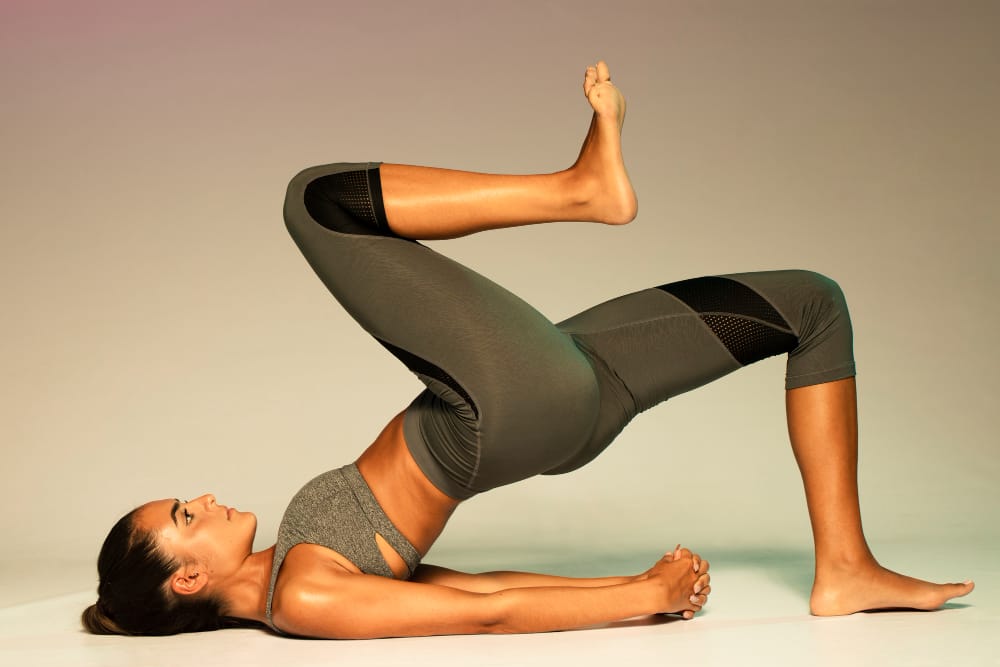
The exercise that changed everything is a refined version of the classic glute bridge. In the Pilates world, this isn’t just about thrusting your hips into the air; it is about Articulated Spinal Control. By moving your spine one vertebra at a time and maintaining a “posterior pelvic tilt,” you deactivate the lower back muscles that usually try to help out.
This isolation forces the gluteus maximus and the hamstrings to work in perfect synchronization with the deep transverse abdominis—the “corset” muscle of your core. This is why my core felt tighter after 30 days of this single move than it did after months of traditional crunches or planks.
Why 30 Days of Isolation Works for Longevity
When you quit high-impact moves like lunges for a month, you allow localized inflammation in your joints to subside. This “Reset Period” is a common strategy in 2026 for athletes looking to extend their training years. The results I saw weren’t just about muscle size; they were about muscle quality.
The 30-Day Transition: Squats vs. Pilates Bridge
| Feature | The Traditional Squat/Lunge | The Pilates Pelvic Bridge |
| Spinal Load | High (Vertical Compression) | Zero (Neutral Spine) |
| Glute Activation | Often “Quad-Dominant” | Pure Glute/Hamstring Isolation |
| Core Impact | Surface Level (Abs) | Deep Stability (Transverse Ab) |
| Joint Tax | Heavy on Knees and Hips | Joint-Friendly / Therapeutic |
| Recovery Time | 48 to 72 Hours | 24 Hours |
How to Master the Move for Maximum Growth
To get the results I did, you cannot just “mindlessly” lift your hips. You have to follow the specific Pilates cues that turn this from a basic stretch into a high-tension strength move.
1. The Setup
Lie on your back with your knees bent and feet flat on the floor, about hip-width apart. Your arms should be at your sides. Ensure your lower back is pressed firmly into the mat—this is the “Imprint” position.
2. The Articulation
Instead of lifting your hips as a solid unit, imagine peeling your spine off the floor like a piece of Velcro. Start with your tailbone, then your lower back, then your mid-back, until you are resting on your shoulder blades. This slow movement forces the deep core to stabilize every inch of the way.
3. The “Knee-Drive”
Once at the top, imagine you are trying to push your knees toward the opposite wall. This lengthens your quads and places a massive “stretch-tension” on the glutes and hamstrings. Hold this position for three seconds, squeezing your glutes as hard as possible.
4. The Descent
Reverse the movement. Lay your spine back down one vertebra at a time, making sure your tailbone is the very last thing to touch the floor.
Adding “The Burn”: Variations for Advanced Strength
Once I hit the 15-day mark, I added small tweaks to keep the intensity high. You don’t need a squat rack to increase the load; you just need to change the leverage.
- Single-Leg Bridge: Lift one leg toward the ceiling while performing the bridge. This doubles the weight on the working glute and challenges your obliques to prevent your hips from dipping.
- The “Pulse” at the Top: Once at the peak of the bridge, perform 20 small, one-inch pulses. This creates Metabolic Stress, which is a primary driver of muscle “shape” and tone.
- Weighted Hold: Place a dumbbell or a heavy book across your hip bones. This adds external resistance to the “squeeze” portion of the move.
The Lower Back Connection: Why the Pain Vanished
Most lower back pain isn’t caused by a “bad back”; it’s caused by “lazy glutes.” In the medical community, this is often called Lower Crossed Syndrome. When your glutes don’t fire, your lower back (erector spinae) has to work overtime to keep you upright.
By spending 30 days forcing my glutes to take the lead, I “retrained” my nervous system. My brain stopped asking my lower back to handle the load of walking, standing, and lifting. Consequently, the chronic tightness I had felt for years simply evaporated. This is the “hidden cleanse” of corrective exercise—you are cleaning up your movement patterns so your joints can finally relax.
Nutrition for Posterior Chain Recovery
Since I was focusing on building muscle density in the glutes, I had to ensure my nutrition supported the “repair” phase. Even though I wasn’t lifting heavy bars, the deep muscular fatigue from Pilates requires high-quality fuel.
The “Glute-Growth” Nutrient Checklist
- Collagen Peptides: To support the tendons and ligaments around the hip joint.
- High Protein (Leucine-rich): To trigger muscle protein synthesis in the glutes.
- Magnesium Glycinate: To prevent the “charley horse” cramps often associated with intense hamstring work.
- Complex Carbs: To keep the muscle glycogen full, giving the glutes a “fuller” appearance.
Related Articles
- The Upper Chest Most Lifters Never Fully Develop — and the Bodybuilder Trick That Finally Fixes It
- Low Volume, Max Results: Why the 30-10-30 Method is the Ultimate Muscle Hack You Need to Try
- The Forgotten King of Strength: One Simple Workout for Total-Body Power (That Isn’t the Deadlift)
- Forget the Barbell: This “Bear Hug Squat” Builds Strength, Fixes Posture, and Adds Years to Your Life
- Is Couch-to-5K Too Hard? Try This Gentle 8‑Week Plan That Gets You to 5K in 2026